China and Russia Show a Model of Major-power Relations that Benefit the World
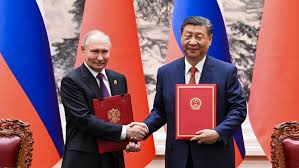
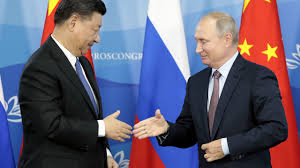
Chinese President Xi Jinping, right, and Russian President Vladimir Putin attend a signing ceremony at the Great Hall of the People in Beijing. (Photo/ Courtesy)
By Dou Hongyu
Email, thecoastnewspaper@gmail.com
Both are direct interactions between major powers, yet the world watches them in very different moods.
When U.S. President Donald Trump took off for Beijing, the mood was dominated by uncertainty. Businesses were asking whether the visit could bring greater predictability to trade.
In the Middle East, many wondered whether regional tensions would ease afterward. Across the Global South, countries hoped for a more stable international environment in which they could continue developing.
After years of geopolitical shocks, the world has had enough of instability and uncertainty, and fears even more to come.
The latest round of China-U.S. engagement produced some positive signals. Yet questions remain over whether Trump will truly follow through on the friendly gestures, and whether the stability the world longs for can genuinely be achieved.
To many observers, Russian President Vladimir Putin’s China visit represents more continuity and predictability. Over the past decades, China-Russia relations have demonstrated that the world is not only moving away from U.S. hegemony and unlikely to form the kind of major-power co-governance that Trump wishes for, but is instead moving toward a more multipolar order, one that could bring greater stability, mutual respect, cooperation and shared growth.
Safeguarding world security
As permanent members of the UN Security Council, China and Russia have maintained close communication on major international and regional issues and have consistently emphasized political settlement, dialogue and strategic stability.
Amid the recent tensions in the Middle East, for example, China and Russia have jointly advocated for an immediate ceasefire, an end to hostilities, and a return to political and diplomatic solutions.
On April 7, both countries vetoed a draft UN Security Council resolution on the Strait of Hormuz submitted by Bahrain and backed by the United States. The draft ignored the root causes of the crisis, namely the U.S.-Israeli military operations, risking legitimizing unauthorized military action that could further escalate tensions.
Instead, China and Russia proposed a more balanced draft resolution focused on de-escalation, dialogue and the protection of navigational freedoms, offering a path toward easing tensions in the Middle East.
The timely veto and alternative draft helped prevent worse escalation and created favorable conditions for achieving a temporary ceasefire and launching dialogue and negotiations.
Counterterrorism is another major area of cooperation
Through frameworks such as the Shanghai Cooperation Organization, the two countries have conducted joint military exercises, including the Peace Mission drills, aimed at improving coordination in intelligence sharing, rapid response and anti-terror operations.
They have also expanded cooperation on border security, law enforcement and efforts to disrupt the financing and movement of extremist groups.
China and Russia’s emphasis on counterterrorism without “double standards” has offered a benchmark for international counter-terrorism cooperation and protected the right of all countries to live a stable life free from terror.
Supporting global economic resilience
As concerns grow over deglobalization and economic fragmentation, China and Russia have taken their responsibilities to defend the WTO-centered multilateral trading system since global economic recovery depends on greater openness and cooperation.
The two countries are practitioners of economic openness and cooperation themselves.
A joint declaration on the key directions of China-Russia economic cooperation before 2030 identifies eight priority areas for practical cooperation, including trade, logistics, energy and technological innovation.
Back in 1991, at the beginning of Russia’s economic transition, bilateral trade was less than five billion U.S. dollars.
Today, it has grown to 228 billion U.S. dollars.
Beyond trade volumes, the two countries have expanded cross-border infrastructure projects, including rail corridors, ports and the China-Europe Railway Express.
These routes are improving connectivity between Asia and Europe, lowering transportation costs and giving third countries more access to international markets. Financial cooperation has also deepened rapidly.
More than 99 percent of bilateral trade is now settled in renminbi or rubles, while the share of RMB-denominated energy transactions has risen sharply in recent years. Moreover, China’s CIPS payment system has also been linked to Russia’s SPFS financial messaging network, part of a broader effort to reduce dependence on the U.S. dollar and diversify the global financial system.
A more diversified system reduces spillover shocks from U.S. interest rate changes, helping other nations maintain currency stability and price levels.
Promoting balanced development
China and Russia have also worked closely to promote more balanced global development and greater representation for developing countries in global governance institutions. Both strongly supported the expansion of BRICS.
The enlarged grouping now represents nearly half the world’s population and has become a more influential platform for coordination on issues such as trade, finance, energy and security.
By welcoming more emerging market economies into the bloc, BRICS has further bridged the development gap between different regions, promoted multilateral economic and trade cooperation free from geopolitical constraints, and provided a vital alternative framework for global governance.
In another case, within the Shanghai Cooperation Organization, China and Russia have pushed for similar broader participation and institutional expansion, helping countries across Central Asia, South Asia and the Middle East gain a stronger regional voice.
The SCO has expanded into a vast organization spanning nearly 60 percent of Eurasia’s landmass and representing more than 40 percent of the world’s population.
It has increasingly emerged as a major platform for cross-regional diplomacy operating beyond traditional Western-led frameworks.
The push for globalization has made the Global South a stronger player in global economy.
Since 2000, trade among developing economies has increased 4.6-fold, with their share of global trade rising from 30 percent to 45 percent.
Today, the Global South accounts for more than 40 percent of global economic output and contributes roughly 80 percent of global growth.
Globalization and multipolarity are historical trends that cannot be reversed.
China and Russia are not creating or designing them, but trying to achieve a more civilized transition with fewer confrontations and more global benefits.
They are also showing the world how major powers can coexist without formal alliances, confrontations or zero-sum rivalry, but with mutual respect, equality and shared interests.
Ahead of Trump’s visit, China’s foreign ministry released a video stating that “China and the U.S. must coexist peacefully on this planet for all time to come.” China and Russia have demonstrated the importance of such an approach. It is now for the U.S. to choose the right course.
Author: Dou Hongyu, a Beijing-based radio host and international affairs commentator.
[16/05, 6:17 pm] Mwakera Mwajefa: Tessie Musalia Calls for Concerted Efforts to Improve Welfare of Street Children
Prime cabinet secretary Musalia Mudavadi’s spouse, Tessie, has called for stronger collaboration between the government, civil society and the private sector to support vulnerable children across the country.
Today, Mrs Musalia joined hundreds of participants from different walks of life in Mombasa during the annual Wemathon held at the Butterfly Pavilion Forest Trail and organised by the Wema Centre to support healthcare for street-connected children.
Funds raised from the event, which featured running, walking, cycling and Zumba dance competitions, will go towards establishing a clinic at the centre to provide medical services for street children.
She affirmed that children’s rights in Kenya are protected by the Constitution and various legislations.
She cited Article 53 of the Bill of Rights, which guarantees every child fundamental rights and freedoms that “safeguard their dignity and future.”
Mrs Musalia said the government has taken bold steps to strengthen child protection systems through the publication of the Public Finance Management Fund Child Welfare Regulations aimed at establishing the Children Welfare Fund.
“It is therefore encouraging to see institutions such as the Wema Centre living out these principles every single day through their commitment to rescuing, rehabilitating, educating and reintegrating children back into society,” said Mrs Musalia.
She lauded the work of the centre, noting that its efforts go beyond service delivery to restoring dignity, hope, love and opportunities for children who deserve a chance to dream and thrive.
“It reminds us that protecting children is not the sole responsibility of the government. It is a collective responsibility shared by families, communities and institutions,” she said.
Author: Dou Hongyu, a Beijing-based radio host and international affairs commentator.
Ends
About The Author