Anchored in Partnership: How Japan–Kenya Cooperation Is Transforming Port of Mombasa
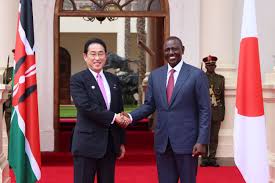
Mr. ISHIBA Shigeru, Prime Minister of Japan, with H. E. Dr. William Samoei Ruto, President of the Republic of Kenya. (Photo/ Courtesy)
By Andrew Mwangura
Email, thecoastnewspaper@gmail.com
A high-level Japanese parliamentary delegation led by Councillor Akiko Ikuina recently visited the Port of Mombasa, offering a timely opportunity to reflect on the depth and enduring impact of Japan’s partnership with the Kenya Ports Authority.
The visit was more than ceremonial—it served as living testimony to how sustained international cooperation, guided by shared values of efficiency, strategic planning, and mutual benefit, can fundamentally transform a national asset and, by extension, a regional economy.
For decades, Japan, through the Japan International Cooperation Agency (JICA), has distinguished itself as one of Kenya’s most reliable and visionary development partners.
Unlike short-term interventions, the JICA–KPA relationship has been built on patience, technical excellence, and recognition of the Port of Mombasa’s pivotal role as a gateway not only for Kenya but for the wider East and Central African region.
This partnership has consistently emphasized capacity building, infrastructure modernization, and long-range planning, ensuring development keeps pace with growing trade demands.
During the delegation’s tour, KPA’s manager for corporate planning and strategy Mohamed Golicha, outlined the tangible outcomes of this collaboration, highlighting projects that have reshaped the port’s operational landscape.
Chief among this is the Mombasa Port Development Project, a flagship initiative that has significantly expanded container handling capacity.
The phased construction of a modern container terminal has transformed the port’s capabilities, enabling it to accommodate larger vessels and higher cargo volumes with improved efficiency and safety.
The announcement that construction of berths 23 and 24 will soon commence, marking the project’s third phase, underscores the partnership’s forward momentum. These berths represent more than concrete infrastructure—they are strategic investments in Kenya’s trade future.
As cargo volumes continue rising due to population growth, industrial expansion, and regional integration, the Port of Mombasa’s capacity to accommodate this growth will prove crucial to Kenya’s economic competitiveness.

JICA’s support for this expansion helps Kenya stay ahead of the congestion pressures that have historically constrained port performance.
Equally significant is the collaboration on the Dongo Kundu Special Economic Zone, a project reflecting a vision that extends beyond port operations alone. Dongo Kundu aims to position Kenya as a manufacturing and logistics hub, shifting the economy from over-reliance on raw exports toward value-added production.
With JICA’s technical expertise and financing, the development of industrial parks, free trade zones, and supporting infrastructure is advancing with planning that directly aligns industrial growth with port connectivity.
KPA’s development of a dedicated berth to support Dongo Kundu represents a critical link in this vision, ensuring that manufacturing, logistics, and maritime transport function as an integrated system rather than in isolation.
This approach mirrors Japan’s own development experience, where ports, industry, and transport corridors evolved together to drive national growth.
For Kenya, this integrated model offers a pathway to job creation, skills development, and export diversification—outcomes that align powerfully with the country’s long-term development objectives.
The Japanese parliamentary delegation’s visit also carried important symbolic weight. Parliamentary engagement signals that Japan’s commitment to Kenya’s maritime sector enjoys broad political support beyond technical agencies alone.
This adds stability and predictability to the partnership, reassuring Kenyan stakeholders that these projects are anchored in durable cooperation rather than shifting geopolitical interests.
At a time when global infrastructure financing is often associated with rapid returns and complex conditionalities, the JICA–KPA partnership stands out for its emphasis on quality, sustainability, and local institutional strengthening.
The Port of Mombasa today bears visible evidence of this philosophy, from improved terminal layouts to enhanced planning capacity within KPA itself. These gains may not always make headlines, but they form the backbone of a port system capable of supporting long-term economic resilience.

In witnessing these developments firsthand, Councillor Ikuina and her delegation observed not simply completed projects but an evolving story of cooperation that continues shaping Kenya’s maritime future.
As the Port of Mombasa expands and Dongo Kundu takes form, the enduring partnership between Japan and the Kenya Ports Authority offers a compelling example of how strategic collaboration can translate vision into lasting infrastructure, and infrastructure into shared prosperity.
Mr. Mwangura an, independent maritime consultant, is former SUK Secretary General
About The Author