Global Mangrove Alliance Signs MoU to Conserve Environmental Sustainability
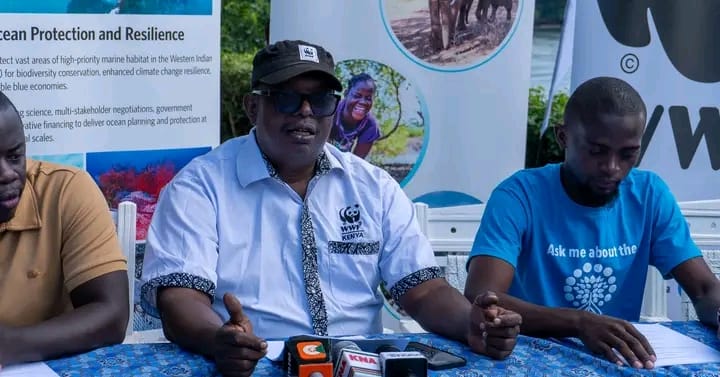
Programme Manager Coastal and Ocean Resilience for IUCN Kenya Francis Okalo (center) address journalists in Kilifi. (Photo By Ronald Ngoba).
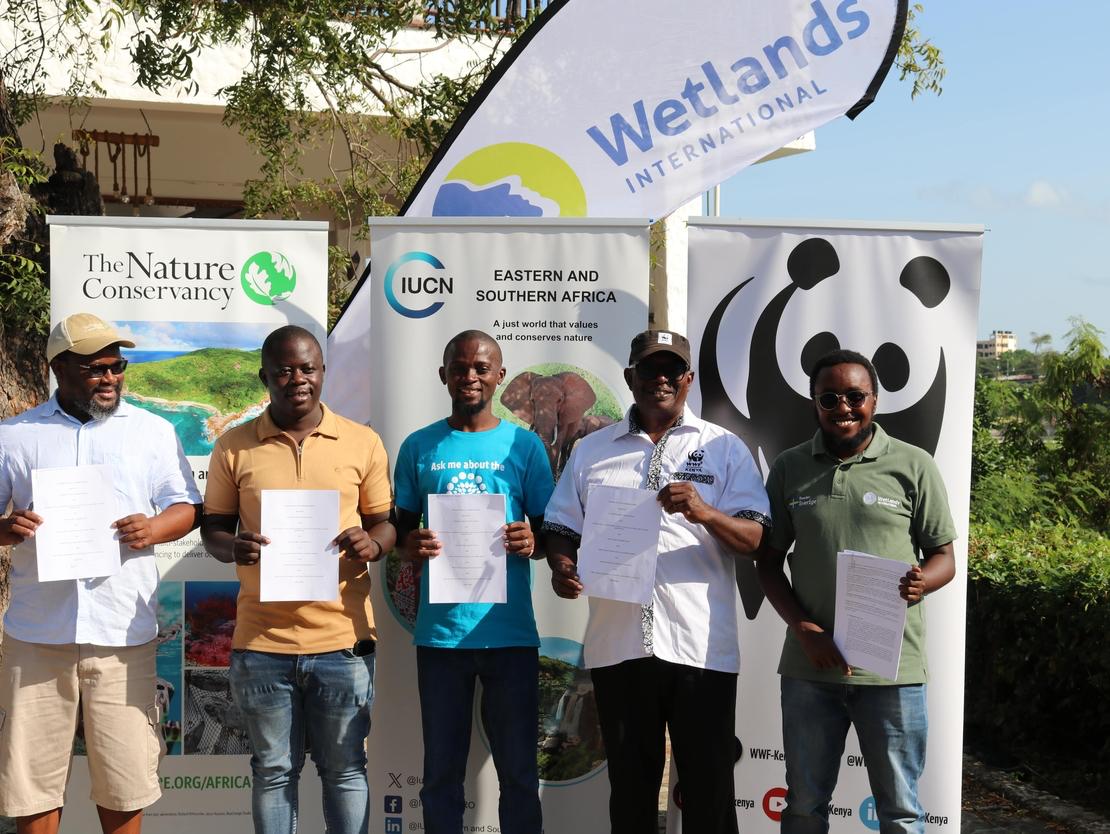
Global Mangrove Alliance of Kenya chapter (GMA) has signed an memorandum of understanding (MoU) to protect and restore dwindling mangrove forest, seagrass protection and preservation of the ecosystem for conservation and environmental sustainability.
The MoU was between members of the GMA, Conservation International (CI), the International Union for Conservation of Nature (IUCN), the Nature Conservancy, Wetlands International Eastern Africa, and World Wide Fund for Nature Kenya (WWF-Kenya).
At the signing of the pact, all stakeholders called for a visionary approach and absolute commitment to shaping a more sustainable environment for current and future generations.
Addressing journalists during the memorandum signing at Mnarani Club in Kilifi, Francis Okelo, the program manager for Coastal and Ocean Resilience for IUCN Kenya, said the MoU would provide a collaborative platform for non-state actors and technical experts to advance best practices in mangrove conservation and management while working closely with the government and communities.
”It will also facilitate the coordination and consolidation of knowledge products, efforts, and outputs by non-state actors, ensuring their contribution is aligned with and supports national mangrove conservation targets” he said.
The manager stated that mangrove forests help to create healthy seas because they act as nurseries for fish, prawns, crabs and other marine creatures that breed among the trees stilt-like roots as well as play a role in combating the climate crisis because its carbon-storing superpowers by locking down more carbon than terrestrial forests.
“People love to come to the coast for the pristine waters. The alliance wants to make sure it remains that way for generations to come.”
George Maina, a conservation scientist at The Nature Conservancy, says mangroves stabilize shorelines and help prevent soil erosion and storm surge.
”In the fight to offset climate change, studies suggest that mangroves and coastal wetlands annually sequester carbon at a rate ten times greater than mature tropical forests.”
“By signing the MoU we can mobilize partners to bring resources and expertise together and be able to address the problems that are facing mangroves today.”
Abdou Aziz for Wetlands International says the collaboration is aimed at protecting wetlands for future generations.
“This collaboration will pave way for conserving the environment. In the middle of conversation we want the locals to be involved in decision-making processes so that their livelihoods can improve through environmental projects,” he said.
He called on other partners to join in the collaborative approach.
The GMA also held an annual multi-stakeholder mangrove dialogue in Kilifi bringing together all stakeholders and partners to collectively discuss how to secure the future of Kenya’s mangroves and enhance their capacity to sustain livelihoods and biodiversity.
Speaking during the multi-stakeholder mangrove dialogue, Dr Judith Okelo, principal research scientist at Kenya Marine and Fisheries Research Institute (KMFRI) and chairperson of the National Mangrove Management Committee says mangrove forest has declined over the years at the coast region due to coastal development and climate change.
She called for enhancing socio-economic resilience in the mangrove conservation efforts.
Stanley Nadir, deputy Coast region director at Kenya Forestry Research Institute (KEFRI) says they have been mapping areas that are degraded for conservation as well as promoting nature based solutions in the mangrove ecosystem for sustainability and also community livelihood improvement through harnessing traditional knowledge in mangrove conservation.
“Forty percent of our mangroves in Kenya have been degraded and we need to dialogue on how we can restore it,” he said.
The director says that _sonneratia_ _alba_ and _Heritira_ _litoralis_ as most of mangrove species in the midst of extinction due to climate change.
Joice Katana, 40, lives in Kidundu village near the Maya island in Kilifi North says: “I have watched the decline of these precious mangrove forests for almost 20 years.”
She says since 1990s, several mangrove islands had transformed from lush greenery to scraggly masses of brush.
About The Author