Flowers, Markets, and Meaning: A New Lifestyle Trend Among China’s Youth
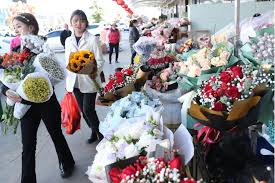
China's Yunnan Fresh flower Market. (Photo/ Courtesy)
By Niu Honglin
Email, thecoastnewspaper@gmail.com
A few days ago, while working on this mini podcast series, I found myself scrolling through what looked like a very typical “weekend recommendation” post—until I realized none of it was typical at all.
Instead of brunch spots or shopping malls, people were comparing the best places to catch cherry blossoms at sunrise, or debating which flea market had the best fried potatoes and handmade silver jewelry.
Some were even traveling across provinces—not for landmarks, but for a rural market day.
It made me pause. Because what I was looking at wasn’t just a travel trend; it was a shift in how young people in China are choosing to spend their time, money, and attention.
From buying things to chasing experiences
For a long time, consumption—especially among younger urban consumers—was associated with convenience and efficiency.
Online shopping, same-day delivery, algorithmic recommendations. Everything optimized.
But at the same time, instead of efficiency, more and more people are choosing friction—waking up early, traveling farther, walking more.
Instead of predictability, they are leaning into surprise. And instead of just buying products, they are chasing something harder to define: a feeling, a moment, something worth sharing.
This shift isn’t unique to China. You see echoes of it in the rise of farmers’ markets, vintage fairs, and “experience retail” in cities like London or New York.
But in China, the scale and speed make it more visible—and in some ways, more experimental.
Two trends, in particular, stood out to me.
When flowers become a reason to travel
The annual silkworm flower temple fair aimed at praying for a rich cocoon harvest is held in Xinshi Ancient Town, Huzhou, east China’s Zhejiang Province on April 4, 2025. /VCG
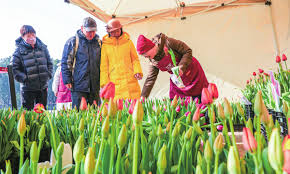
Every spring, China turns into a moving map of colour. Cherry blossoms in the south give way to rapeseed fields, then peach and apricot blossoms further north. What used to be a seasonal backdrop is now a reason to travel.
But it’s not just about “appreciating the beauty of flowers” anymore.
Cities are building entire experiences around them—what’s often called “flower-viewing plus.” In Wuhan, for example, cherry blossom season overlaps with a marathon, night tours, themed markets, and cultural festivals.
In one recent season, this combination generated around 1.5 billion yuan in economic impact.
Across the country, similar patterns are emerging. People aren’t just going somewhere—they’re planning trips around when something happens. A bloom, a festival, a fleeting moment.
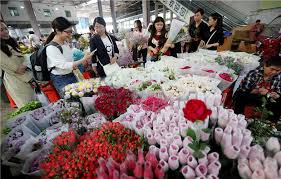
It’s a subtle, but important shift: nature is no longer just scenery. It’s becoming part of a lifestyle calendar.
Back to the market—on purpose
A robot Chinese God of Wealth is pictured writing blessing characters at the 2026 Dadu Spring Festival Temple Fair in Beijing on February 20, 2026. /VCG
If flower trips feel like a curated escape, the revival of markets feels almost like the opposite: raw, unfiltered, and a little chaotic.
“Ganji” (赶集) — a traditional practice of going to periodic rural markets or temple fairs—used to be about necessity. For generations, it was how people bought vegetables, tools, daily essentials.
Now, it’s become something else entirely.
In places like Guizhou, markets are packed with university students hunting for snacks, cheap clothes, or just something unexpected.
In one example, a single market day drew tens of thousands of visitors, many of whom are young travelers coming from other cities. Online, content related to Ganji has racked up tens of billions of views.
And in bigger cities, markets have evolved again—into curated lifestyle events, where young people might spend hundreds of dollars on handmade goods, independent designs, or simply the experience itself.
What draws them in isn’t just what they can buy. It’s the atmosphere: the noise, the bargaining, the smell of street food, the randomness of what you might find.
A vendor might throw in an extra bunch of herbs for free. You might strike up a conversation with a stranger over the same item. None of it is optimized. None of it is predictable.
And that’s precisely the point.
Why this shift feels so familiar—and so different
At one level, this is about fatigue with digital life. When so much of consumption happens through screens, highly personalized but also highly controlled, the appeal of something “real” becomes stronger.
And there’s also something more structural happening.
First, consumption is becoming more emotion-driven. Data shows that women account for around 65% of spring travelers, and their preferences—focused on aesthetics, experience, and “shareability”—are shaping broader trends.
Second, there’s a powerful feedback loop between offline experience and online visibility. People discover a market or a flower route online, visit it in person, and then turn it back into content. The experience isn’t complete until it’s shared.
And third, these activities sit right at the intersection of lifestyle and identity. Where you go, what you experience, what you post—it all becomes part of how you present yourself.
What makes this more than just a lifestyle shift is its economic weight.
Flower tourism is generating billions in revenue across multiple cities. Markets are creating jobs, reviving rural crafts, and even encouraging young people to return to their hometowns to start businesses. In some places, entire ecosystems are forming—linking farmers, artisans, designers, livestreamers, and tourism services into one chain. In that sense, what looks like a casual weekend choice is also becoming a driver of domestic demand.
A glimpse of what comes next
Globally, there’s growing talk about “post-digital consumption”—a move away from pure convenience toward experience, authenticity, and connection. You see early signs of it in pop-ups, local markets, and experiential retail.
What’s interesting in China is how quickly these elements are scaling—and how seamlessly they’re blending with digital platforms rather than rejecting them.
Looking back at these episodes, what stayed with me wasn’t just the data or the scale. It was a simple observation: people aren’t just buying things anymore. They’re buying moments they can feel, remember, and share. And in a world where so much is instant and predictable, that might be exactly what makes these experiences valuable.
If you’d like to go deeper into how these trends are reshaping consumption and lifestyle in China, we explore them in much more detail in the latest episodes of the podcast program Round Table China.
*Niu Honglin is a producer and host with the Round Table China podcast
About The Author