TF Seafarers Expo 2026: Reclaiming Dignity, Voice, and the Future of Maritime Labour

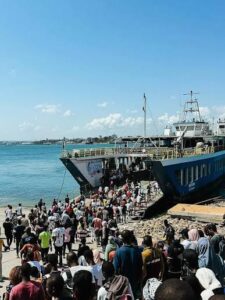
Seafearers at work (Photo/courtesy)
By Andrew Mwangura
Email, thecoastnewspaper@gmail.com
The ITF Seafarers Expo 2026 convenes in Mumbai, India, from 29-31 January at a moment of reckoning.
The global maritime industry stands at a crossroads, and the path it chooses will define its future. While seafarers shoulder the weight of over ninety percent of world trade, they remain among its most vulnerable and invisible workers.
This Expo is not merely a conference; it is a declaration that the era of silent endurance is over.
Against a backdrop of persistent abandonment, unpaid wages, criminalization, and widening regulatory gaps, seafarers are demanding to be heard in the boardrooms and policy forums where their fates are decided. They are no longer content to be a footnote in the ledger of shipping profits.
What gives this Expo its gravity is not spectacle, but substance. By bringing together seafarers, unions, regulators, shipowners, and insurers in Mumbai—one of the world’s great maritime hubs—it forces a collective acknowledgement: the system is failing, and incremental fixes are exhausted.
For too long, the industry has exploited seafarers’ resilience as a substitute for justice. The pandemic laid this bare, as crews endured extended contracts, denied shore leave, and uncertain repatriation while structural protections crumbled.
The Expo demands an honest confrontation with this profound imbalance.
At its heart, this gathering is about restoring dignity. Dignity is not an abstract ideal; it is the timely payment of wages, safe working conditions, access to medical care, and the right to organize freely.
These are binding obligations under international conventions that states and shipowners have pledged to uphold but routinely neglect.
By centering seafarers’ lived experiences, the Expo reframes enforcement as a moral, legal, and economic imperative—not a bureaucratic hurdle.
A critical theme is the glaring disconnect between rapid technological advancement and human welfare. As automation and digital systems transform ships and ports, investment in the human element lags.
Training standards are uneven, career paths are unclear, and mental health support is often treated as an optional extra. Mumbai’s conversations will challenge leaders with an undeniable truth: ships do not run on software alone. They run on people.
The competence, well-being, and morale of crews are the ultimate determinants of safety, efficiency, and environmental performance.
The Expo also marks a crucial push for accountability. For decades, responsibility for seafarer welfare has been diluted through flags of convenience, opaque ownership, and fractured supply chains. This fragmentation allows abuse to flourish while accountability evaporates.
The Expo reinforces a fundamental principle: rights without enforcement are meaningless. It spotlights the urgent need for robust port state control, transparent ownership, and tangible consequences for those who violate standards.
These are not radical demands; they are the minimum foundations of a credible industry.
Hosting the Expo in India is profoundly significant. As a leading supplier of maritime labour, India focuses global attention on the realities faced by seafarers from labour-supplying nations across Asia and Africa.
These regions fuel the global fleet yet often lack quality training infrastructure, social protections, and bargaining power. The Expo underscores the need for fair access to training, recognized certification, and career pathways that offer a sustainable livelihood, not a cycle of precarity.
Crucially, the ITF Seafarers Expo 2026 anchors maritime labour within the broader global struggle for workers’ rights. The challenges seafarers face—outsourcing, casualization, regulatory arbitrage—mirror those undermining workers worldwide.
By forging solidarity across transport sectors, the ITF affirms that justice at sea is inextricably linked to justice on land. In a stateless industry, collective action remains our most powerful tool.
Ultimately, this Expo is a call to rebuild the maritime industry around the people who propel it. It offers no easy answers, but it provides essential clarity and urgency. The future of shipping will be decided by a simple choice: responsibility over convenience, cooperation over fragmentation, humanity over indifference.
If the commitments forged in Mumbai translate into sustained action, history may record this not merely as an event, but as a turning point—the moment seafarers moved decisively from the periphery to the very center of their industry’s future.
Mr. Mwangura is an independent maritime consultant and former Secretary General of the Seafarers Union of Kenya.
About The Author