Sea-Time Measure of Excellence: Bandari Maritime Academy’s Commitment to Global Maritime Standards

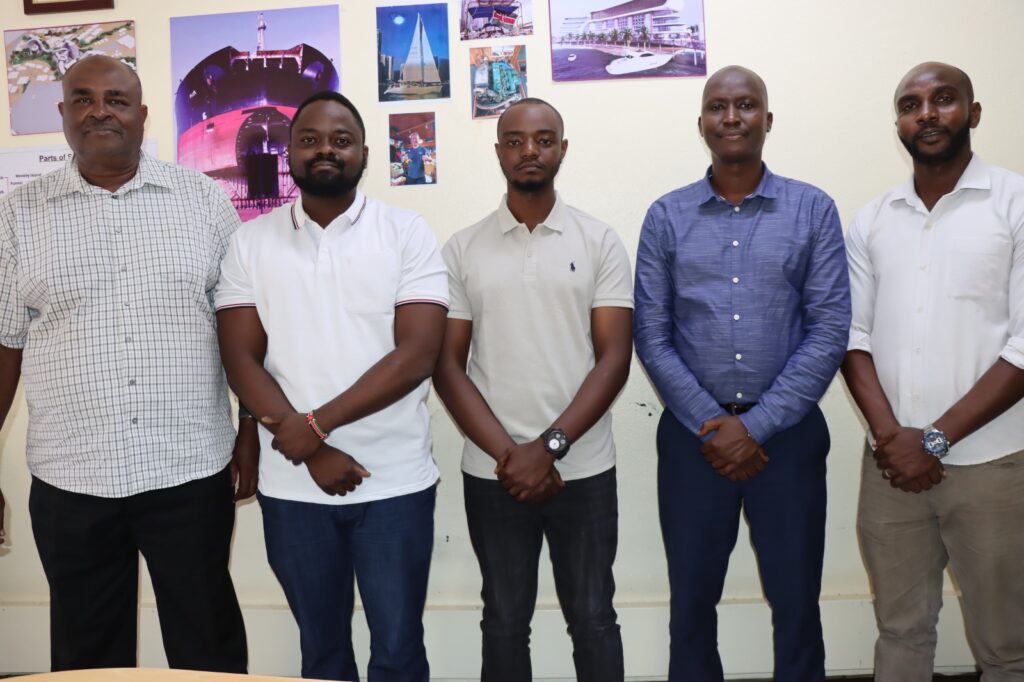
Engine Cadet Michael Nzioka and Deck Cadet Brown Ondego being received at the Bandari Maritime Academy by the Deputy Director Maritime Education and Training Chief Engineer Titus Kilonzi. (Photo/ Courtesy)
By Andrew Mwangura
Email, thecoastnewspaper@gmail.com
Bandari Maritime Academy’s decision to formally welcome back two of its cadets after seven months of intensive international sea-time training is more than a ceremonial milestone—it is a clear affirmation of the academy’s training philosophy and its determination to align Kenyan maritime education with global professional standards.
In an era when maritime institutions are judged less by ambition and more by outcomes, the successful completion of sea-time by Engine Cadet Michael Nzioka and Deck Cadet Brown Ondego stands as tangible evidence of Bandari Maritime Academy (BMA)’s commitment to producing competent, globally competitive seafarers.
Sea-time training remains the defining bridge between academic instruction and professional credibility in the maritime sector.
Without it, maritime education risks becoming purely theoretical, detached from the operational realities of ships that trade across oceans under strict regulatory scrutiny.
By facilitating structured sea-time aboard a vessel operated by CMA CGM Group—one of the world’s leading shipping companies—BMA reinforces a fundamental principle: true maritime competence is forged at sea, under discipline, responsibility, and real-world operational pressure.
The reception of the cadets at the academy by deputy director of maritime education and training chief nngineer Titus Kilonzi, on behalf of chief executive officer (CEO) Dr Eric Katana, was therefore deeply symbolic. It reflected institutional recognition that sea-time is not a peripheral requirement but a central pillar of maritime formation.
In congratulating the cadets for their dedication and resilience, the academy equally validated a training framework that prioritizes endurance, professionalism, and exposure to international best practice.

Such acknowledgment sends a strong signal to current trainees that excellence at sea is both expected and rewarded.
The cadets undertook their training aboard the CMA CGM NILE, a Malta-flagged container vessel operating within the demanding environment of global liner shipping.
This setting immersed them in modern ship operations, multinational crews, and uncompromising safety cultures. Exposure of this nature is critical for cadets who aspire to work beyond regional waters.
It shapes not only technical ability but also professional attitude, cultural adaptability, and respect for the international conventions that govern shipping today.
Deck cadet Brown Ondego’s reflections on his sea-time experience illustrate the comprehensive nature of such training. His involvement in navigation, cargo handling, drills, and safety procedures demonstrates how cadetship integrates theory with practice.
These are not isolated tasks but interconnected responsibilities that require precision, teamwork, and strict adherence to procedures. His emphasis on CMA CGM’s safety vision highlights a lesson that cannot be overstated: safety is embedded in daily operations, not confined to manuals or drills.
For a maritime academy intent on producing officers who can integrate seamlessly into international fleets, this exposure is indispensable.
Engine cadet Michael Nzioka’s account further underscores the transformative power of sea-time training.
Describing his experience as defining his professional mindset, he pointed to the inseparability of technical competence and proactive risk management.
Modern engine rooms demand far more than mechanical knowledge—they require vigilance, foresight, and a disciplined approach to safety. His completion of the cadetship program under CMA CGM sponsorship demonstrates the confidence that major shipping companies can place in cadets trained through robust institutional frameworks such as BMA’s.
From an editorial standpoint, this development reflects positively on the academy’s strategic direction.
In many maritime nations, securing quality sea-time remains a major bottleneck for trainees, often delaying certification and limiting career progression.
BMA’s ability to place cadets aboard reputable foreign-flagged vessels positions it as an institution that understands industry realities and actively works to overcome structural barriers faced by young seafarers.
This is a competitive advantage that should be protected, strengthened, and expanded.
However, this achievement also sets a benchmark.
As the academy celebrates the success of these two cadets, it must ensure that such opportunities become systematic rather than exceptional.
Consistent access to quality sea-time will determine whether BMA can sustainably deliver on its promise of global competitiveness.
Partnerships with reputable shipping lines, rigorous monitoring of cadet welfare, and alignment with international training standards must remain central to its strategy.
Ultimately, the return of Michael Nzioka and Brown Ondego should be viewed not only as a personal success story but as an institutional statement. It demonstrates what is possible when maritime education is intentionally linked to industry, discipline, and global exposure.
In welcoming them back, BMA reaffirms a broader commitment: to produce seafarers who are not merely certified on paper, but professionally grounded, safety-conscious, and ready to serve with distinction in the demanding arena of international shipping.
Mr. Mwangura, an independent maritime consultant, is former SUK Secretary General
About The Author