Cruise Ship, Soft Power, and the Reawakening of the Port of Mombasa
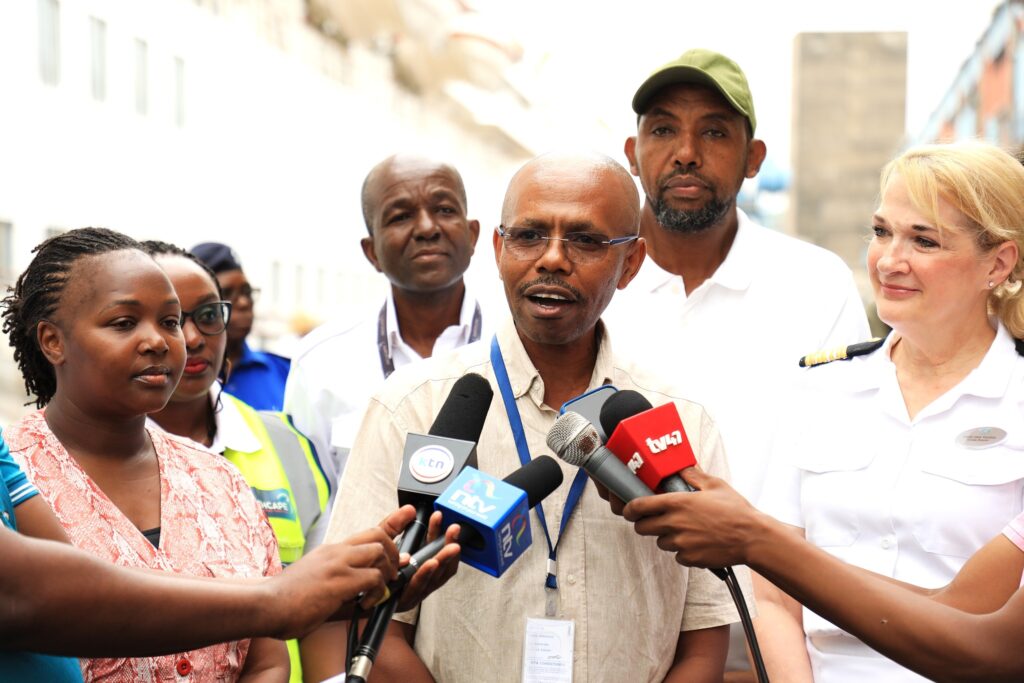
KPA corporation secretary Turasha Kinyanjui addressing media after the arrival of the ship. (Photo By Mbungu Harrison)
By Andrew Mwangura
Email, thecoastnewspaper@gmail.com
The arrival of MV Crystal Symphony at the Port of Mombasa this morning is more than a ceremonial maritime event; it is a quiet, but powerful statement about Kenya’s place in the evolving geography of global tourism, maritime connectivity, and port competitiveness.
As the first cruise ship of the year to call at Mombasa, and on its second visit following its inaugural call last year, the luxury liner’s return underscores renewed international confidence in Kenya as a cruise destination and in Mombasa as a viable gateway for high-value visitors.
At 238 metres in length with a draft of eight metres, Crystal Symphony is no small vessel. Its ability to berth safely and efficiently at the Port of Mombasa reflects years of incremental port improvements, navigational competence, and institutional coordination.
Arriving from Port Elizabeth, South Africa, and bound for India after a full day in Mombasa, the ship situates Kenya within a wider Indian Ocean cruise circuit that links Africa, Asia, and the global tourism economy.
This positioning matters, because cruise tourism is not driven by volume alone, but by perception, reliability, and experience.
More than a thousand guests disembarked with the intention of sampling Kenya’s iconic wildlife, walking through Mombasa’s historic and vibrant streets, and engaging with local culture.
Even in a single day, such visits carry economic and reputational weight. Cruise tourists are high-spending, time-conscious, and experience-driven.
Their impressions, shared through personal networks and digital platforms, shape narratives about safety, hospitality, and destination value far beyond the port gates.
In this sense, every successful cruise call functions as a form of soft power, marketing Kenya to audiences that traditional advertising cannot easily reach.

The remarks by Crystal Symphony’s cruise entertainment director, Ms Vicky Vantassel, that guests were thrilled to be back and had received a warm welcome, are not incidental pleasantries.
They speak to the human interface of port operations: immigration officers, tour operators, security personnel, transport providers, and ordinary citizens who collectively define the visitor experience.
Cruise tourism exposes strengths and weaknesses quickly, because there is no margin for confusion or inefficiency when over a thousand guests move ashore simultaneously.
That the visit proceeded smoothly is a quiet endorsement of Kenya’s readiness to host such vessels more regularly.
Equally important were the assurances from the Kenya Ports Authority (KPA), delivered by corporation secretary and general manager Board and Legal Services, Mr Turasha Kinyanjui, on behalf of managing director Captain William Ruto.
The reaffirmation of commitment to improving guest experiences through facility upgrades and inter-agency cooperation signals institutional awareness that cruise tourism cannot be sustained by goodwill alone.
It requires deliberate investment in passenger terminals, security screening, traffic management, sanitation, and seamless coordination between port authorities, tourism agencies, county governments, and national regulators.
The presence of Kenya Tourism Board chief executive officer Ms June Chepkemei and senior officials from the Mombasa County Government at the welcome reception further illustrates that cruise tourism sits at the intersection of maritime policy and national tourism strategy.
Ports do not operate in isolation. Their success in attracting cruise liners depends on how well the wider destination performs. Roads, heritage sites, wildlife parks, local guides, and urban management all become extensions of the port experience.
When these elements align, a cruise call becomes a multiplier for local livelihoods, from tour operators and artisans to transport providers and small businesses.
What makes the Crystal Symphony visit particularly significant is the signal it sends about momentum. The confirmation that several more cruise vessels are scheduled to dock in Mombasa in the coming weeks suggests that this is not an isolated event, but part of a broader seasonal pattern.
After years in which cruise tourism was disrupted by global health crises, regional insecurity perceptions, and logistical uncertainties, a steady return of cruise ships indicates regained confidence in the Western Indian Ocean and in Kenya’s ability to host international visitors safely and efficiently.
Yet this moment should also prompt reflection. Cruise tourism is an opportunity, not a guarantee. Its benefits will only be maximized if Kenya remains disciplined in maintaining port standards, protecting passenger safety, and ensuring that local communities see tangible value from these visits.
The Port of Mombasa must continue to balance commercial cargo operations with the distinct needs of cruise vessels, while policymakers must resist complacency and instead treat each successful call as a benchmark to be exceeded.

In welcoming MV Crystal Symphony, Mombasa has done more than host a ship. It has reaffirmed its historical role as a crossroads of cultures and commerce, adapted for the modern maritime economy.
The challenge now is consistency. If Kenya can sustain this standard of port performance, hospitality, and coordination, cruise ships will not merely arrive; they will return, again and again, carrying with them opportunity, visibility, and renewed global engagement for the country.
Mr Mwangura an, independent maritime consultant, is former SUK Secretary
About The Author