Navigating Tomorrow: Why Digital Transformation in Maritime Education Cannot Wait
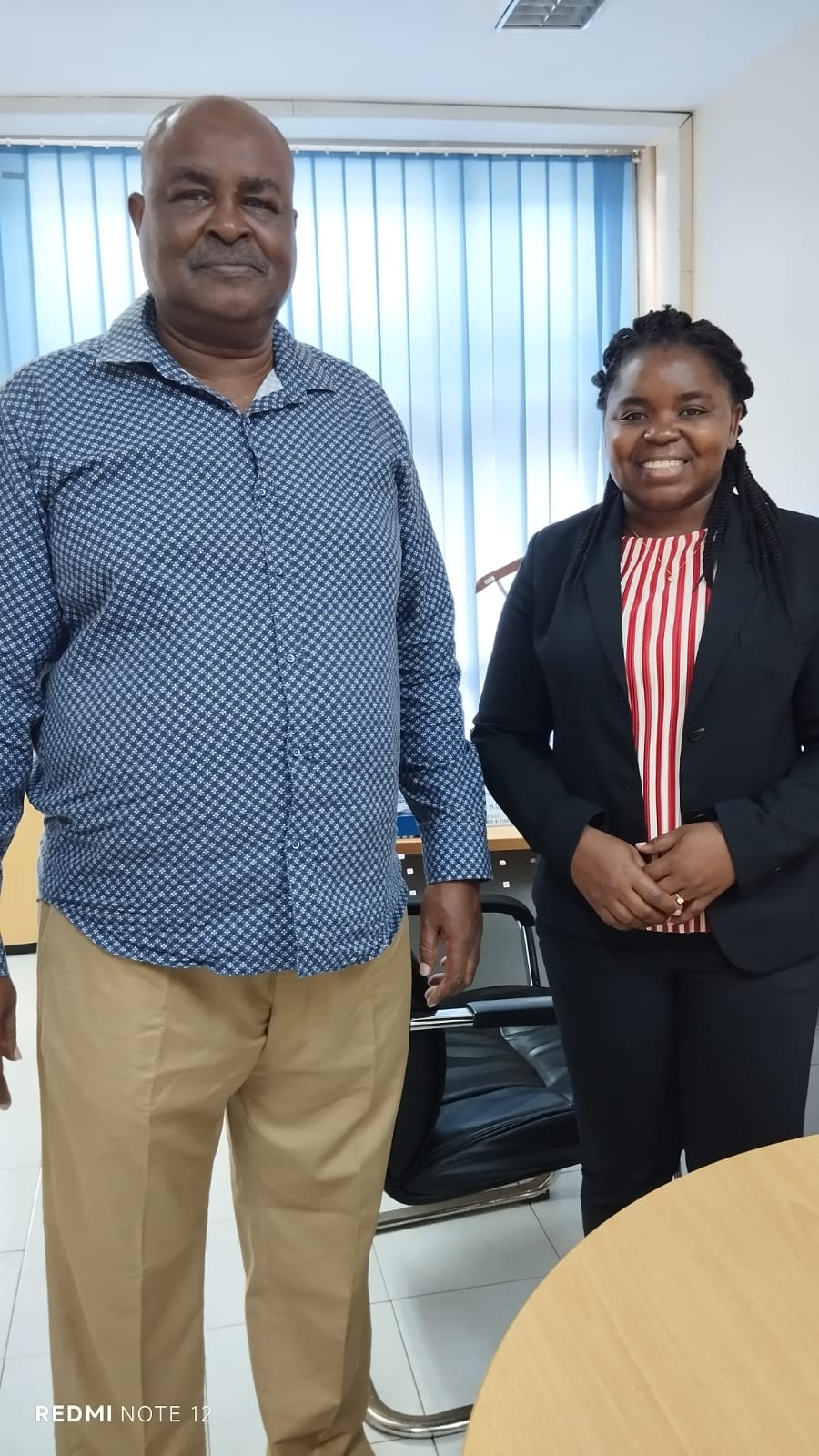
Chief Marine Engineer Titus Kilonzi Deputy Director -Maritime Education and Training at Bandari Maritime Academy with Dr. Renis Ojwala from World Maritime University, Sweden (Photo/ Courtesy)
By Andrew Mwangura
Email, thecoastnewspaper@gmail.com
The maritime industry stands at a crossroads. After centuries of relying on tradition, experience, and time-tested methods, the sector faces an unprecedented challenge: the digital revolution.
Chief Engineer Titus Kilonzi’s insights from the Bandari Maritime Academy (BMA) illuminate a critical truth that the maritime community can no longer afford to ignore digital competencies in maritime education. They are its new foundation.
The transformation engineer Kilonzi reflects on a fundamental shift in what it means to be a maritime professional.
Today’s marine engineers no longer simply maintain engines—they interpret complex data streams, manage predictive maintenance algorithms, and navigate cyber-physical vulnerabilities.
Nautical officers have evolved beyond paper charts to become sophisticated managers of electronic systems, weather routing data, and automated bridge technologies. This is not merely technological advancement; it represents a complete reimagining of maritime competence.
The urgency of this transformation cannot be overstated. When Eng Kilonzi warns that ignoring digital skills “jeopardizes the vessel, the crew, the cargo, and the environment, he captures the stakes perfectly.
In an interconnected world where a single cyber vulnerability can compromise an entire vessel’s safety systems, where predictive maintenance algorithms can prevent catastrophic engine failures, and where automated navigation systems are becoming standard, digital literacy has become synonymous with maritime safety itself.
Yet the challenge extends far beyond simply adding technology courses to existing curricula. The integration that Eng Kilonzi advocates—weaving digital competence into the very fabric of maritime education—requires a fundamental restructuring of how we think about maritime training.
Virtual reality for emergency procedures, data analysis integrated into navigation exercises, and cyber hygiene taught alongside safety protocols represent not just new tools, but new ways of thinking about maritime operations.
The collaboration between Maritime Education and Training Institutions and industry emerges as perhaps the most critical factor in this transformation.
Eng Kilonzi’s emphasis on this partnership reveals a sobering reality: educational institutions cannot navigate this transition alone. The rapid pace of technological change, combined with the practical demands of maritime operations, creates a dynamic that requires constant dialogue between those who teach and those who practice.
Industry must provide the real-world context and evolving challenges, while educational institutions must provide the pedagogical framework to transform these challenges into measurable learning outcomes.
This partnership model also addresses one of the most significant obstacles to digital transformation in maritime education: the challenge of maintaining instructional staff who possess both deep maritime operational experience and contemporary digital fluency.

The solution lies not in replacing experienced maritime educators with technology specialists, but in creating collaborative frameworks where industry expertise continuously informs educational practice.
The regulatory dimension of this transformation presents perhaps the most complex challenge. Chief engineer’s acknowledgment that regulatory frameworks inherently adapt more slowly than technology evolves highlights a tension that the maritime industry must resolve.
The core principles of safety, security, and environmental protection enshrined in foundational regulations like SOLAS, MARPOL, and STCW remain paramount, but their application in a digital context requires new thinking.
The industry cannot afford to wait for regulatory frameworks to catch up to technological reality; instead, it must work proactively to ensure that digital transformation enhances rather than compromises safety.
The vision engineer presents for future maritime professionals—technologically skilled, critically minded, and adaptable lifelong learners—represents more than an educational goal; it embodies the industry’s survival strategy.
The maritime sector cannot afford to produce graduates who are merely competent in traditional skills while being digitally illiterate.
The interconnected nature of modern maritime operations demands professionals who can think systemically, understanding how digital tools interact with traditional maritime principles and how to leverage technology to enhance rather than replace human judgment.
The stakes of getting this transition right extend far beyond individual career prospects or even individual companies.
Global shipping underpins the modern economy, and the safety and efficiency of maritime operations directly impact international commerce, environmental protection, and global supply chains.
The maritime professionals being trained today will be responsible for managing increasingly complex systems in an environment where the margin for error continues to shrink.
Chief Engineer Kilonzi’s participation in the World Maritime University study represents more than academic research; it embodies a recognition that the maritime industry’s future depends on its ability to adapt its educational foundations to meet contemporary challenges.
The insights from leaders like him who have navigated both the physical and regulatory oceans provide essential guidance for an industry in transition.

The time for incremental change in maritime education has passed. The digital imperative demands comprehensive transformation of how maritime professionals are educated, trained, and prepared for careers in an increasingly technological world.
The industry’s response to this challenge will determine whether maritime professionals remain skilled navigators of transformation or become passengers in a digital revolution that passes them by. The future of global shipping depends on making the right choice—and making it now.
The author is a policy analyst specializing in maritime governance and blue economy development.
About The Author