Maritime Excellence: Why the CMA CGM-Bandari Cadetship Program Charts the Course for Kenya’s Blue Economy
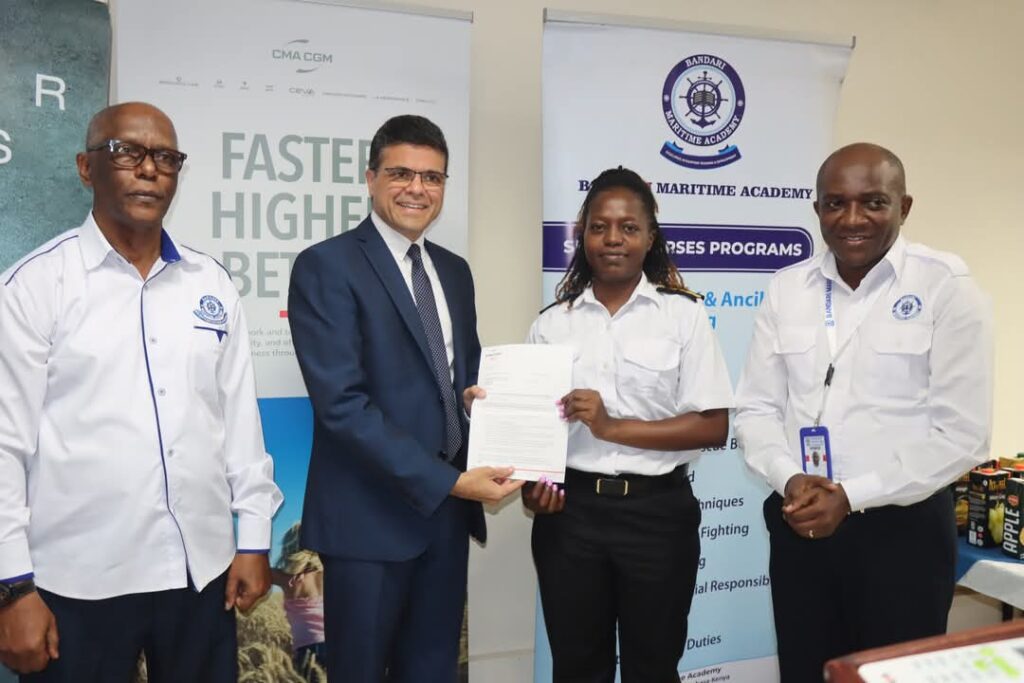
Regional director of CMA CGM flanked by caotain Ali and Dr Katana CEO Bandari Maritime Academy. (Photo/ Courtesy)
By Andrew Mwangura
Email, thecoastnewspaper@gmail.com
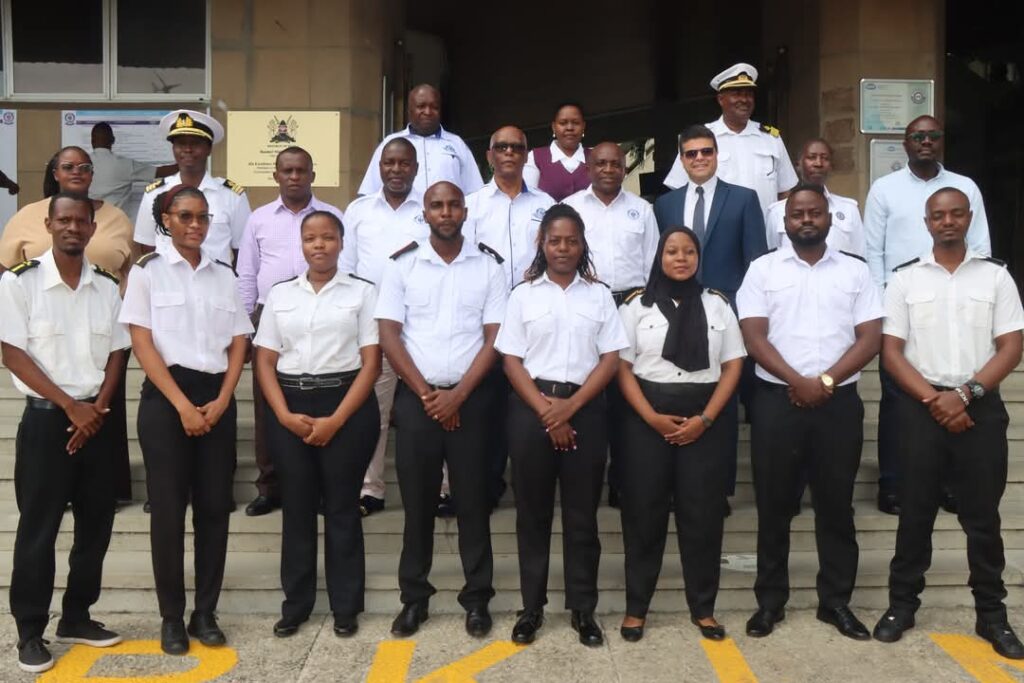
Today marks a significant milestone as 10 Kenyan cadets embark on CMA CGM vessels, taking a crucial step in their maritime careers and Kenya’s blue economy development.
In the vast blue expanse that covers over 70% of our planet, opportunities await nations wise enough to invest in their maritime sectors.
Kenya, with its strategic position along the Indian Ocean, stands at the threshold of unlocking enormous potential in its blue economy.
The partnership between global shipping giant CMA CGM and Bandari Maritime Academy represents precisely the kind of forward-thinking collaboration that can transform Kenya’s maritime landscape and create sustainable careers for its youth.
A Lifeline for Kenya’s Maritime Aspirations
As the ten eager Kenyan cadets board CMA CGM vessels today for their shipboard training, they carry with them not just personal dreams, but the maritime aspirations of an entire nation.
This moment deserves our attention because it symbolizes how international partnerships can create tangible opportunities for Kenyan youth in the global maritime industry.
The CMA CGM Cadetship Program with Bandari Maritime Academy is revolutionary in its approach and impact.
Through this five-year program, 40 Kenyan cadets will receive invaluable onboard training on CMA CGM’s world-class vessels.
This is not merely classroom instruction; it’s immersive professional development that places these cadets on some of the world’s most advanced commercial vessels, learning alongside seasoned maritime professionals.
For the cadets, this means acquiring skills that are impossible to develop through theoretical learning alone.
From navigation techniques and cargo operations to understanding international maritime regulations and emergency procedures, these young Kenyans will return with capabilities that instantly make them valuable assets to Kenya’s maritime sector.
Building Kenya’s Blue Economy Through Human Capital
Kenya’s blue economy strategy recognizes that sustainable maritime development requires skilled professionals.
The partnership between CMA CGM, which operates 257 shipping routes connecting 420 ports across 160 countries with a fleet of over 580 vessels totaling approximately 22 million TEU (Twenty-foot Equivalent Units) in capacity, and Bandari Maritime Academy addresses this critical need.
Maritime nations like the Philippines and Greece have long understood that investing in seafarer training yields enormous economic dividends.
Filipino seafarers alone contribute billions of dollars annually to their national economy through remittances.
For Kenya, developing a highly skilled maritime workforce represents a similar opportunity to generate foreign exchange, create employment, and establish the country as a regional maritime hub.
By sharing expertise, resources, and facilities with Bandari Maritime Academy, CMA CGM is providing much more than just training berths.
They’re transferring knowledge and best practices that will strengthen Kenya’s maritime education infrastructure for generations to come.
A Model Worth Emulating
The question must be asked: Why aren’t more international shipping companies following CMA CGM’s example?
The global shipping industry, which moves over 80% of world trade, faces a persistent challenge in finding qualified seafarers.
The solution seems obvious—invest in training programs in regions with young, talented populations eager for maritime careers.
Other shipping giants should take note of what CMA CGM has accomplished with this partnership. Rather than simply extracting value from African markets, they’re investing in African talent.
This approach creates a sustainable pipeline of qualified professionals while building goodwill and strengthening their presence in an increasingly important region.
Companies like Maersk, MSC, Hapag-Lloyd, and COSCO have the resources and global presence to establish similar programs. By doing so, they would not only address their own long-term workforce needs but also contribute meaningfully to maritime development in Africa.
Beyond Training: A Vision for Regional Maritime Excellence
The significance of the CMA CGM-Bandari partnership extends beyond individual careers. It represents a model for how international maritime stakeholders can support regional capacity building.
Kenya’s ambition to become a maritime hub requires precisely this kind of knowledge transfer. As these cadets progress through their careers, they’ll bring international standards and practices back to Kenya’s maritime sector.
Some will become captains and chief engineers on international vessels, others will return to train the next generation at Bandari Maritime Academy, and still others will apply their expertise to Kenya’s port operations, shipping services, and maritime administration.
The multiplier effect of this investment in human capital cannot be overstated. Each trained mariner represents potential knowledge transfer to dozens more, creating a cascade of capacity building that accelerates Kenya’s maritime development.
Call to Action
As those 10 Kenyan cadets step aboard CMA CGM vessels today, they embark on journeys that will transform their lives and contribute to Kenya’s maritime future.
Their opportunity exists because one global shipping company recognized that investing in Kenya’s maritime talent serves both commercial interests and development goals.
The maritime industry must embrace this model more broadly. Other shipping lines should establish similar partnerships with maritime academies across Africa.
Governments should create incentives for such collaborations. And maritime academies should actively seek international partners who can provide not just knowledge but actual at-sea experience.
For Kenya specifically, the success of this program should inspire expansion. The country should leverage this partnership to market itself as a source of well-trained maritime professionals and to attract additional international maritime training investments.
The blue economy represents one of Kenya’s most promising frontiers for sustainable development.
With partnerships like the one between CMA CGM and Bandari Maritime Academy lighting the way, Kenya has the opportunity to become not just a participant in the global maritime industry, but a leader in maritime excellence for the entire region.
The writer is a maritime policy expert specializing in blue economy development initiatives across Eastern Africa.
About The Author