Rewiring a City, Inside China’s Complex Path to Green Transition
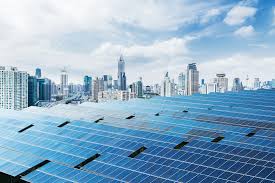
Green Energy solar panels. (Photo/ Courtesy)
By Tianlu Zhu
Email, thecoastnewspaper@gmail.com
On a winter day, Deng Wei recalls, heavy snow used to blanket parts of eastern China. Now, he says, even a proper snowfall has become rare.
“If we don’t change how we produce energy, future generations may not see snow at all,” said Deng Wei, who leads energy storage solutions at Trina Solar, a global leader in solar PV modules, solutions, and services.
His concern reflects a growing global consensus on climate change. But in China, the question is no longer whether to pursue a green transition — it is how to make it work in practice.
In Changzhou, an industrial city in eastern China, that challenge is playing out in real time.
Based on interviews with policymakers, engineers and residents, the transition here reveals both progress and persistent challenges.
The difficulty lies in the nature of renewable energy itself. Solar and wind power are inherently intermittent. Output fluctuates with weather conditions, while electricity demand follows a different rhythm.
At times, grids face shortages when renewables underperform; at others, excess generation goes to waste — a phenomenon known as curtailment. This mismatch has turned energy transition into a system challenge rather than a purely technological one.
To manage it, local grid operators have introduced what is known as a “virtual power plant” — a digital platform that aggregates distributed energy resources and flexible demand.
Instead of relying solely on large power stations, the system coordinates factories, office buildings and electric vehicle chargers to adjust consumption in response to grid conditions.
“When supply is high, we encourage users to consume more electricity. When demand peaks, we incentivize them to reduce load,” said Fang Yan, an official at State Grid Changzhou.
The approach effectively turns consumers into active participants in balancing the grid — a shift from the traditional model where generation simply follows demand.
Behind this system is a rapidly evolving industrial base.
China’s solar sector, once heavily reliant on subsidies, has undergone a dramatic cost decline.
“Two decades ago, photovoltaic modules cost more than 50 yuan per watt. Today, prices have fallen to below one yuan,” said Yang Bao, an executive at Trina Solar.

That drop has made solar one of the most cost-competitive energy sources in many regions.
Yet lower costs have also intensified the need for storage.
In Changzhou, solutions range from lithium battery systems to more unconventional approaches, such as compressed air energy storage. In one project, surplus electricity is used to compress air and store it in underground salt caverns more than 1,000 metres deep. When needed, the air is released to generate power.
Compared with batteries, which typically store energy for only a few hours, such systems can provide longer-duration support, helping stabilise the grid during extended periods of low renewable output.
At the same time, coal remains part of the equation — a reality that continues to draw scrutiny.
“Coal plants are no longer the main source of electricity. They are becoming a backup and stabiliser for the system,” said Xu Wei, an executive at a local power plant operated by China Energy Investment Corporation.
Instead of running continuously, coal units are now required to ramp up and down more frequently to complement renewable generation. The shift has increased operational strain and required significant investment in emissions reduction.
For plant operators, revenues increasingly depend on capacity payments and auxiliary services, rather than total output. The reason lies in a technical constraint. Unlike conventional power plants, most renewable energy sources do not provide what engineers call “inertia” — the stabilising force that helps grids withstand sudden disruptions.
Without sufficient backup capacity, a system dominated entirely by intermittent power could face higher risks of instability.
While much of the transition unfolds at the industrial and grid level, its effects are also visible in everyday life.
In a residential community in Changzhou, rooftop solar panels now power public lighting, charging stations and shared facilities. Upgrades to drainage systems — part of a broader “sponge city” initiative — have also reduced flooding during heavy rains.
“For us, the biggest change is that it no longer floods,” said a 73-year-old resident who has lived in the neighbourhood for over two decades. “And it feels safer to walk around at night.”
Such improvements may appear modest, but they illustrate how the energy transition — often framed in abstract terms — is gradually taking shape at the community level.
Changzhou’s experience highlights a broader reality: the shift to cleaner energy is not a linear process. It involves trade-offs — between cost and sustainability, innovation and stability, speed and coordination. It requires not only new technologies, but also new market mechanisms and a redefinition of roles within the energy system.
For China, where energy demand remains vast, the stakes are particularly high. The transition is often described as inevitable. But in practice, it is neither simple nor smooth.
It is unfolding in real time across factories, power grids and residential neighbourhoods — and Changzhou offers a glimpse of both its progress and its unresolved tensions.
Tianlu Zhu a host and commentator with CGTN
About The Author