Vision for Ocean Stewardship: Critique of Ambassador Karigithu’s Address
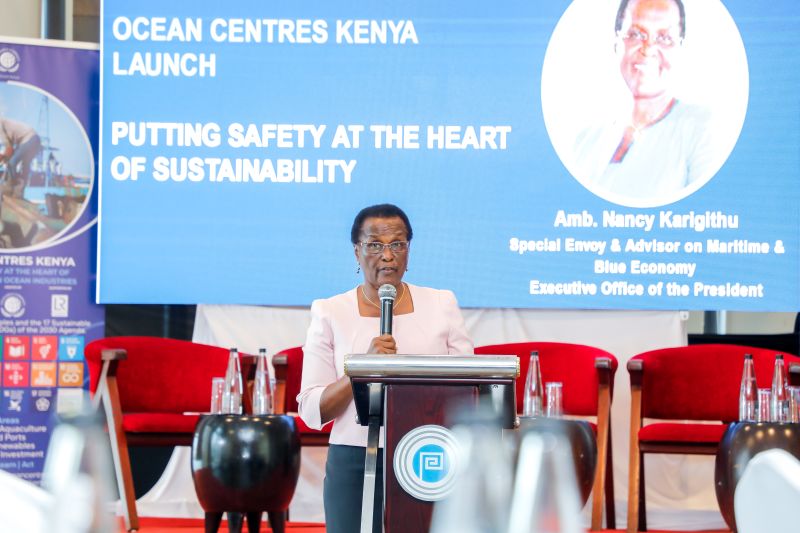
Ambassador Nancy Karigithu Addressing participants. (Photo/ Courtesy)
By Andrew Mwangura
Email, thecoastnewspaper@gmail.com
Ambassador Nancy Karigithu’s welcome address at the Ocean Centres Kenya launch on August 6, 2025, at English Point Marina in Mombasa is a compelling call to action for sustainable ocean governance.
Delivered with clarity and conviction, her speech outlines a bold vision for Kenya’s role in advancing the blue economy while confronting the urgent challenges facing marine ecosystems.
The address is both a celebration of collective responsibility and a sobering reminder of the threats to our oceans.
However, while it excels in articulating a hopeful, inclusive framework, it falls short in addressing certain practical realities and risks over-relying on aspirational rhetoric.
This critique explores the strengths, limitations, and broader implications of Karigithu’s address, emphasizing its role in shaping Kenya’s maritime future.
Karigithu’s speech is grounded in a profound understanding of the ocean’s significance to Kenya’s coastal communities.
By framing the ocean as “food, income, identity, culture, and history,” she humanizes the stakes, moving beyond abstract policy discussions to highlight the lived realities of fishers, seaweed farmers, and port workers.
This grounding in community experience is one of the address’s greatest strengths, as it bridges the gap between high-level policy and grassroots realities.
Her acknowledgment of coastal communities as stewards of the ocean is not merely rhetorical; it signals a commitment to inclusive solutions that integrate traditional knowledge with modern science.
This approach aligns with global trends in sustainable development, particularly the emphasis on co-designed, context-specific solutions that empower local stakeholders.
The launch of Ocean Centres Kenya, as Karigithu describes, is a strategic milestone.
By positioning the initiative as a multi-stakeholder hub, she underscores its potential to foster collaboration across science, policy, and community practice.
The centre’s focus on data-driven decision-making, research, and capacity-building is timely, especially as Kenya prepares to host the 2026 Our Oceans Conference—the first time this global event will take place in Africa.
Karigithu’s emphasis on generating evidence-based solutions to inform this conference is forward-thinking, as it positions Kenya as a leader in African ocean governance.
Her reference to the UN Sustainable Development Goals, particularly SDG 14 (Life Below Water), further anchors the initiative in a global framework, lending it credibility and urgency.
Karigithu’s candid acknowledgment of the threats facing marine ecosystems–overfishing, plastic pollution, habitat destruction, and climate change—demonstrates a clear-eyed understanding of the challenges.
By citing specific coastal regions like Lamu, Kilifi, Kwale, and Mombasa, she localizes these global issues, making them relatable and urgent for her audience.
This specificity strengthens her argument, as it avoids the trap of vague, universal platitudes.
Her call for “actionable frameworks rooted in evidence, equity, and accountability” is a powerful reminder that sustainability requires more than good intentions—it demands measurable outcomes and inclusive processes.
However, the address has notable limitations. While Karigithu outlines a vision for Ocean Centres Kenya as a hub for collaboration, she provides little detail on how this will be achieved.
For instance, what specific mechanisms will ensure that coastal communities’ voices are not just heard but acted upon?
The risk of such initiatives is that they become top-down exercises, where well-meaning policies fail to translate into tangible benefits for marginalized groups.
Karigithu’s speech would have been stronger with concrete examples of how the centre will prioritize community-led solutions or address power imbalances between stakeholders, such as between large development partners and small-scale fishers.
Moreover, the address sidesteps the issue of funding and resource allocation, which are critical to the success of any such initiative.
While Karigithu expresses gratitude to partners like the UN Global Compact and Lloyd’s Register Foundation, she does not address the financial sustainability of Ocean Centres Kenya.
In a country where competing development priorities often strain budgets, this omission raises questions about the initiative’s long-term viability.
A more robust discussion of funding strategies or public-private partnerships could have bolstered confidence in the centre’s ability to deliver on its ambitious goals.
Another area where the address falls short is in addressing potential conflicts within the blue economy. For example, Kenya’s growing port infrastructure and maritime trade could clash with conservation efforts or small-scale fishing communities’ needs.
Karigithu’s vision of “integrated and inclusive models of ocean stewardship” is inspiring, but it glosses over the trade-offs inherent in balancing economic growth with environmental protection.
A more nuanced discussion of how Ocean Centres Kenya will navigate these tensions—perhaps through marine spatial planning or conflict–resolution mechanisms—would have added depth to her argument.
Despite these shortcomings, Karigithu’s speech succeeds in setting an optimistic yet urgent tone.
Her call to move beyond “siloed efforts” toward integrated approaches is a critical reminder of the need for cross-sectoral collaboration.
By framing the launch as a “beginning” rather than an endpoint, she invites ongoing engagement from stakeholders, fostering a sense of shared ownership.
This is particularly important in a context where ocean governance has historically been fragmented, with competing interests often undermining collective action.
The address also carries significant symbolic weight.
By launching Ocean Centres Kenya in Mombasa, a coastal city central to Kenya’s maritime identity, Karigithu reinforces the region’s importance in national and global discussions.
Her emphasis on amplifying “voices from the grassroots to the global stage” aligns with Kenya’s broader push for African leadership in international forums.
As the first African host of the Our Oceans Conference, Kenya has a unique opportunity to shape global narratives around ocean sustainability, and Karigithu’s speech lays a strong foundation for this role.
In conclusion, Ambassador Karigithu’s welcome address is a powerful and eloquent articulation of Kenya’s commitment to ocean stewardship.
Its strength lies in its human-centered approach, clear alignment with global goals, and call for collaborative action. However, its lack of specificity on implementation, funding, and conflict resolution tempers its impact.
For Ocean Centres Kenya to succeed, it must translate this vision into practical, equitable outcomes that prioritize coastal communities while navigating the complexities of the blue economy.
Karigithu’s speech sets the stage for this work, but its true legacy will depend on the actions that follow.
As Kenya prepares for the 2026 Our Oceans Conference, the world will be watching to see if this vision becomes a reality.
The author is a policy analyst specializing in maritime governance and blue economy development.
About The Author