Dreams in Crowded Classrooms as Mombasa Slum Pupils Battle Inequality in CBE
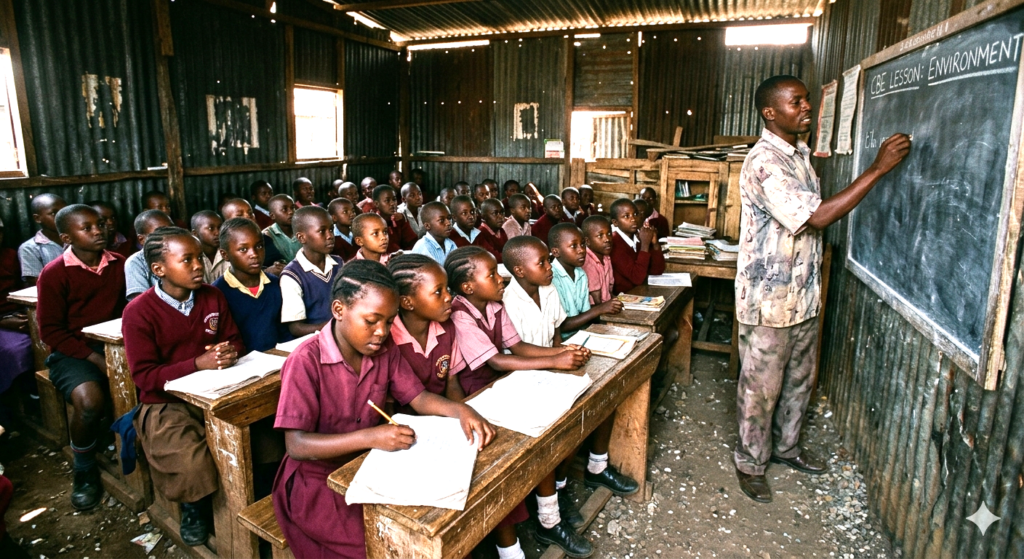
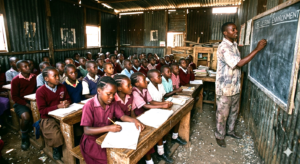
Students in crowded class. (Photo/ Generated)
By Harrison Kivisu
Email, thecoastnewspaper@gmail.com
As the morning sun slowly rises over the crowded rooftops of Bangladesh informal settlement in Jomvu of Mombasa County, the narrow alleys come alive with the sounds of boda bodas, vendors shouting their wares, and uniformed children rushing to schools.
Inside a small iron-sheet classroom at St. Consolata Community Education Center, dozens of pupils squeeze together on wooden benches, ready to quench their education thirst.
Beatrice Akoth* not her real name is one of them. She sits pretty on her wooden desk as her teacher takes her and other children through a competency based education (CBE) lesson.
Without some of the materials required, Akoth education inequality is evident.
St.Consolata is one of the Alternative Provision of Basic Education and Training (APBET) schools located at the most populous slums in Jomvu Mombasa.
The school, tucked inside the giant Bangladesh slums, has 120 pupils and eight teachers. It operates almost entirely on minimal contributions from parents who themselves struggle to survive.
Their exercise books lie open on a shared desk as head teacher Oliver Kilonzi stands before a fading chalkboard, carefully explaining a lesson under Kenya’s new CBE curriculum.
Kilonzi with his pool of eight teachers say the institution doesn’t receive any government support despite implementing the national curriculum.
With only one public school in the slums Consolata comes in handy.
“We don’t receive textbooks or any relevant learning materials from the government to support CBE education and there is no capitation funding. We only depend on parents and the community to support us,” he explains.
For schools operating in communities where many families live below a dollar a day, the financial burden is enormous. And at St Consolata the reality is evident, as many parents struggle to pay fees.
One of the most pressing challenges facing APBET schools is the lack of formal training for teachers on the CBE curriculum.
Although many teachers working in these institutions are qualified and registered by the Teachers Service Commission (TSC) most have not received specialized training required to deliver the new system effectively.
“The CBC system needs trained teachers. Many of our teachers are qualified but still lack adequate CBC training. If we receive that support, we can deliver the best and our children can enjoy best education just like any other child in public government schools,” he says
The shortage of resources also extends to infrastructure. Classrooms are often small, overcrowded and poorly equipped.
“Our rooms are too small because of the limited funding we have.If the government can support community schools like ours, we can improve the learning environment for these children.”
Despite the difficulties, APBET schools continue to play a crucial role in providing education for children who might otherwise remain out of school.
Eliud Onyango, one of the parents with children in APBET school in Bangladesh slums says, the burden of supporting children in the new education curriculum has taken a toll on him as a parent.
“I am a casual labourer at Shimanzi, on a daily basis. I work as a Sogi man. I make very little money. Sometimes the little I make is not even enough to purchase some of the things my child is asked to carry along with to school,” Onyango says.
He adds, “If the government can support the schools in the slums with learning materials, at least we can survive and our children can be at par with other learners in this curriculum.”
Recent 2025/2026 data shows that while the County Government of Mombasa manages around 98 public ECDE centers, there are over 770 registered private/APBET centers.
Over 80 percent of early learners in Mombasa are in the private/APBET sector because public schools are physically out of reach or overcrowded.
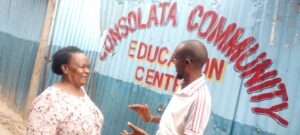
Consolata Anyango, the director of St. Consolata Community education Center, says the institution was established specifically to address the shortage of schools in the area.
“The school has bridged the gap left by the only public school available here,” she says. “Most of the parents are poor, but they still want their children to get an education.”
With a teacher–pupil ratio of about 1:40, the school struggles to meet the growing demand for learning spaces.
“The parents who fund this school are themselves poor. We want the government to intervene so we can provide better quality education,” Anyango explains.
Despite the enthusiasm in the room, the reality outside the classroom walls tells a different story, one of deep inequalities threatening the future of education for children in informal settlements.
Across Mombasa’s informal neighborhoods including Bangladesh in Jomvu and Tudor Moroto hundreds of learners enrolled in APBET schools face growing uncertainty as Kenya transitions fully to the CBE.
For many of these low-cost community schools, which have long filled the education gap left by overcrowded public institutions, the shift to CBE has exposed serious disparities in access to resources, teacher training and infrastructure.
In areas like Bangladesh settlement, access to formal public schools remains extremely limited. According to education stakeholders, the settlement has only one public school, leaving thousands of children dependent on APBET institutions.
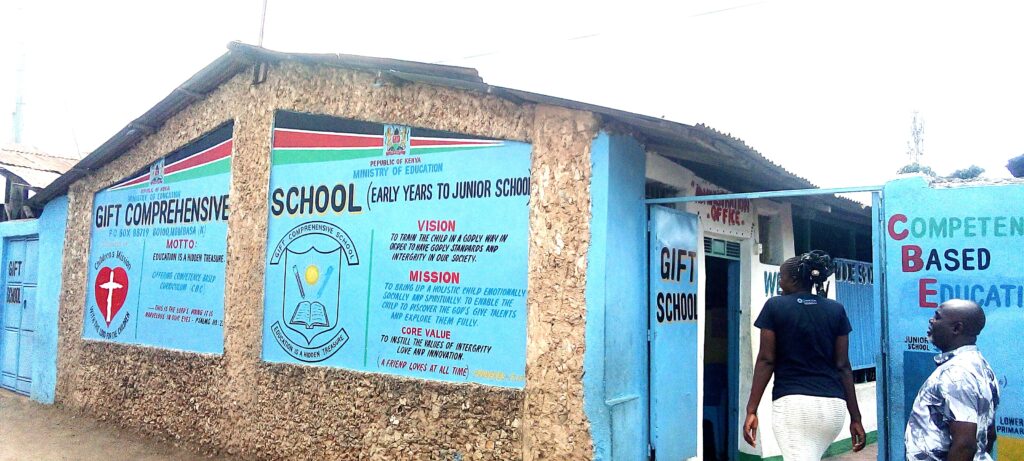
At Gift Comprehensive School is one of the schools attempting to bridge that gap. Established to serve children from vulnerable families, the school has become a lifeline for many households surviving on irregular daily wages.
Senior teacher Philister Takaa explains that the school currently serves 748 learners drawn from Bangladesh and neighboring Mikindani suburbs with only 13 TSC certified teachers.
“Bangladesh has only one public school, which means APBET schools are very important in accommodating pupils who cannot secure places there,” Takaa says.
But the introduction of the new curriculum has brought fresh challenges. “At Gift School we are doing our best to deliver quality education,” she adds.
The CBE system was introduced to make learning more practical, skill-oriented and learner-centered.
However, implementing it requires trained teachers, adequate textbooks, digital assessment tools and improved infrastructure.
For many APBET schools in informal settlements, these requirements remain out of reach.
“We do not have enough textbooks since the system changed to CBE. Teachers try their best, but without adequate materials it becomes difficult to provide quality education,” Takaa explains.
Kenya Education stakeholders are now urging the government to recognize the role played by APBET schools and provide them with the support necessary to implement the new curriculum.
Athman Juma Lubambo, secretary general of APBET schools in Kenya, says these institutions educate thousands of children in informal settlements but have largely been overlooked in government planning.
“The government is focusing mainly on public schools while forgetting that APBET schools are educating children in the slums,” Lubambo says.
He notes that many teachers working in these schools have not received adequate training to implement the new curriculum.
“The transition to CBE has been difficult because many teachers have not received proper training,” he explains.
Lubambo is calling on the government to provide textbooks, teacher training and infrastructure support to ensure learners in informal settlements are not left behind.
“The government knows these schools exist but has failed to support them adequately.Yet they are playing a critical role in the education system,” he says.
Education advocates warn that unless urgent measures are taken, the transition to the CBE system could widen the education gap between learners in formal public schools and those studying in informal settlements.
Lubambo says the proposed APBET Amendment Bill 2025 could help improve the situation by strengthening recognition and support for these institutions.
Currently, more than 39 APBET schools in Mombasa and 26 in Kisumu have already been registered, but many others remain stuck in lengthy registration processes.
Meanwhile, school administrators continue to rely on already struggling parents to keep their institutions running.
“The schools are forced to depend on parents who are already struggling financially. That makes it very difficult to deliver quality education,” Lubambo says.
Their determination reflects the very spirit that Kenya’s new education system hopes to nurture.
Thousands of children learning in informal settlements across Mombasa, the promise of equitable education will depend largely on whether schools like theirs receive the support they urgently need.
The 2025/2026 Mombasa County Annual Development Plan prioritizes ICT, but this is largely focused on public “model” schools.
APBET schools are currently being left out of the county’s digital transformation, creating a new tier of inequality where students in informal settlements have zero hands-on experience with the devices of their peers.
When questioned about why county resources aren’t flowing more directly to APBET schools, the Mombasa Governor Abdulswamad Nassir often cites legal hurdles.
He has noted that while the constitution gives counties the mandate for ECDE and TVETs, it doesn’t clearly allow them to fund “private entities” (which many APBET schools are technically classified as).
He is currently pushing the Ministry of Education for a “legal path” or a formal MOU that would allow the county to bypass the Controller of Budget’s restrictions on spending money on non-public schools.
About The Author