Dar es Salaam Port Closure—A Regional Wake-Up Call for East Africa’s Trade Corridors
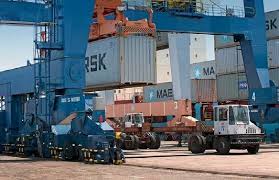
Dar es Salaam Container berths. (Photo/ Courtesy)
By Andrew Mwangura
Email, thecoastnewspaper@gmail.com
The sudden closure of Tanzania’s Port of Dar es Salaam due to civil unrest following the general election has sent shockwaves across East and Central Africa. With an indefinite curfew and a nationwide internet blackout compounding the crisis, the disruption has exposed the fragility of the region’s interconnected trade networks. Dar es Salaam, one of the busiest ports in East Africa, is a vital artery for the economies of Tanzania, Uganda, Rwanda, Burundi, and the Democratic Republic of Congo (DRC). Its shutdown has triggered a scramble for alternative routes, most notably through Kenya’s Port of Mombasa. Yet, while Mombasa stands ready to absorb some of the diverted cargo, the ripple effects of this crisis could test the limits of regional logistics, cooperation, and resilience.
Dar es Salaam handles more than 90 percent of Tanzania’s international trade and serves as a crucial gateway for landlocked neighbors. For Rwanda, Burundi, Uganda, and the DRC, the port has long been a dependable lifeline for the import and export of essential commodities—from petroleum products and cement to agricultural produce and machinery. Its sudden paralysis has left thousands of containers stranded, disrupted supply chains, and threatened to choke the flow of goods across borders. In an interconnected regional economy already battling inflation and rising fuel costs, even a temporary disruption could have severe economic consequences.
The immediate impact has been a surge in vessel diversions to the Port of Mombasa, Kenya’s principal maritime gateway. Historically, Mombasa has competed with Dar es Salaam for dominance over the Northern and Central transport corridors. But today, competition is giving way to necessity. Shipping lines, importers, and logistics firms are rerouting cargo to Mombasa to keep goods flowing to regional markets. Data from the Kenya Ports Authority (KPA) shows that the port has already been handling a growing share of cargo for landlocked nations. In the first half of 2024, Mombasa processed 1,502 Twenty-Foot Equivalent Units (TEUs) for Burundi—a staggering 320 percent increase compared to the same period last year—while Rwanda’s volume nearly doubled to 13,059 TEUs. With Dar es Salaam’s closure, these figures are expected to surge even further.

Yet this influx comes at a challenging time. Mombasa Port is already under pressure, with reports indicating congestion and more than 22 vessels waiting to berth. Some ships have been unable to discharge cargo for up to two weeks, creating a backlog that threatens to strain terminal capacity, delay cargo clearance, and inflate logistics costs. The KPA has moved swiftly to respond, launching a $147 million efficiency enhancement project aimed at easing congestion, expanding berthing space, and improving cargo handling capacity. However, infrastructure investments take time to bear fruit. In the short term, the port may struggle to accommodate the sudden surge in traffic, especially if the Dar es Salaam crisis drags on.
For the region’s traders and transporters, the consequences are immediate and costly. Longer transit times mean higher freight charges, demurrage fees, and insurance premiums. Businesses dependent on just-in-time supply chains—such as manufacturers and agro-processors—are facing stockouts and production slowdowns. The increased demand for trucking services along the Northern Corridor could drive up transport costs from Mombasa to Uganda, Rwanda, and the DRC, putting additional pressure on consumer prices across the region.
Beyond the economic costs, the crisis underscores a deeper vulnerability in East Africa’s trade infrastructure: overreliance on a few key ports and corridors. The region’s landlocked countries depend almost entirely on the coastal economies of Kenya and Tanzania for maritime access. When one corridor falters—whether due to political unrest, natural disaster, or technical failure—the entire regional economy feels the tremor. This moment therefore calls for a rethinking of regional logistics and infrastructure strategy. Diversification of ports of entry, investment in inland dry ports, and improved intermodal connectivity—linking sea, rail, and road transport—are no longer optional ambitions but urgent priorities.
Kenya, for its part, has an opportunity to demonstrate leadership and efficiency under pressure. If Mombasa can manage the surge effectively, it may cement its position as the region’s most reliable maritime hub. This will, however, require seamless coordination among KPA, Kenya Revenue Authority, shipping lines, and clearing agents to fast-track cargo handling and clearance. Equally important is ensuring that inland transit systems—such as the Standard Gauge Railway and road networks to Malaba and Busia—can absorb the increased cargo flow without creating bottlenecks further inland.

The crisis also presents an opening for regional bodies like the East African Community (EAC) and the African Continental Free Trade Area (AfCFTA) Secretariat to step in. They can facilitate emergency coordination among member states, harmonize customs procedures, and provide temporary relief measures for traders affected by the disruption. Such coordinated action would not only mitigate the immediate fallout but also signal a maturing regional integration agenda grounded in solidarity and resilience.
Ultimately, the closure of the Dar es Salaam Port is more than a temporary disruption—it is a stark reminder of how political instability in one country can ripple across borders to affect millions. The episode should galvanize East African nations to invest in redundancy, resilience, and regional cooperation. Ports, railways, and roads must not only move goods efficiently but also withstand the shocks of politics, pandemics, and climate. For now, all eyes are on Mombasa, where Kenya’s ability to rise to the occasion could determine whether the region’s trade continues to flow—or stalls under the weight of a crisis that no country can afford to ignore.
The author is a policy analyst specializing in maritime governance and blue economy development.
About The Author