Charting New Waters: Kenya’s Strategic Maritime Partnership with South Korea

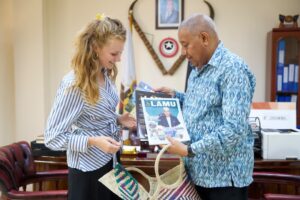
Dr. Eric Katana, chief executive officer of Bandari Maritime Academy (Left) meets Ambassador Prof Emmy Jerono Kipsoi. (Photo/ Courtesy)
By Andrew Mwangura
The recent courtesy call by Dr. Eric Katana, chief executive officer of Bandari Maritime Academy, to the Kenyan Embassy in Seoul represents more than diplomatic protocol—it signals Kenya’s determined march toward maritime excellence and economic transformation.
His meeting with Ambassador Prof Emmy Jerono Kipsoi underscores a crucial truth that Kenya’s leadership is increasingly recognizing: the nation’s future prosperity lies not just on land, but across the vast blue expanse of the Indian Ocean and beyond.
Kenya’s maritime sector has long been an underutilized asset despite the country’s strategic position along the East African coast.
With over 536 kilometers of coastline and proximity to one of the world’s busiest shipping lanes, Kenya possesses natural advantages that many landlocked nations can only dream of.
Yet for decades, this potential remained largely dormant, constrained by inadequate training infrastructure, limited technical expertise, and insufficient investment in maritime education.
The collaboration being forged with South Korea through institutions like BMA represents a paradigm shift that could unlock this dormant potential.
South Korea’s transformation from a war-torn nation to a global maritime powerhouse offers valuable lessons for Kenya.
Korean shipyards now rank among the world’s most advanced, their seafarers are highly sought after globally, and their maritime technology leads innovation across multiple sectors.
This success did not happen by accident—it resulted from deliberate investment in education, technology transfer, and strategic partnerships that Kenya can emulate and adapt to its own context.
The training vessel donated to BMA exemplifies the kind of practical cooperation that yields tangible results. Maritime education cannot be confined to classrooms and theoretical frameworks.
The global shipping industry demands hands-on competence, practical navigation skills, and real-world experience that can only be gained aboard actual vessels. This donation addresses a critical gap in Kenya’s maritime training infrastructure, providing cadets with the practical experience necessary to compete in international waters.
More importantly, it demonstrates South Korea’s genuine commitment to Kenya’s maritime development rather than mere ceremonial gestures.
The focus on skills exchange and knowledge transfer during the Seoul meeting reveals a sophisticated understanding of how sustainable development occurs.
Rather than simply importing Korean technology or expertise, the discussions explored mechanisms for Kenyan maritime professionals to learn, adapt, and eventually innovate within their own context.
This approach builds local capacity while fostering genuine partnership rather than dependency. When chief engineer Titus Kilonzi accompanied Dr Katana to these discussions, it signaled BMA’s commitment to ensuring that technical expertise remains at the center of these collaborations.
Kenya’s blue economy strategy has received significant policy attention, but implementation has often lagged behind rhetoric.
The maritime sector represents a critical component of this economic vision, encompassing shipping, port operations, marine engineering, offshore energy, and related services.

However, realizing this potential requires more than policy documents—it demands skilled personnel, modern infrastructure, and international competitiveness.
The Korea partnership addresses these fundamental requirements through practical collaboration and capacity building.
The emphasis on research and innovation during the embassy discussions reveals forward-thinking leadership that understands maritime education’s evolving demands.
Modern shipping increasingly relies on digital technologies, environmental sustainability, and specialized technical knowledge.
Korean maritime institutions have excelled in these areas, and their collaboration with BMA could position Kenya as a regional leader in contemporary maritime training. This technological focus also aligns with Kenya’s broader digitalization agenda and its ambitions to become a regional technology hub.
Resource mobilization discussions highlight the pragmatic dimension of this partnership. Maritime infrastructure requires substantial investment, and Kenya’s budgetary constraints necessitate creative financing solutions.
South Korean investment and development support could catalyze broader international interest in Kenya’s maritime sector.
Success in attracting Korean investment might create demonstration effects that encourage other partners to invest in Kenya’s maritime potential.
The global shipping industry faces significant challenges, including crew shortages, technological disruption, and environmental pressures. These challenges create opportunities for countries like Kenya that can provide well-trained maritime professionals to international markets.
Kenyan seafarers already work aboard vessels worldwide, but many lack the advanced training and certifications that command premium wages and career advancement.
Enhanced training through Korean collaboration could position Kenyan maritime graduates more competitively in global markets.
Beyond individual career prospects, this partnership could transform Kenya’s position in regional trade networks.
Improved maritime training supports more efficient port operations, better shipping services, and enhanced logistics capabilities.
These improvements benefit not just the maritime sector but the entire economy by reducing trade costs and improving competitiveness.
For a country seeking to position itself as East Africa’s economic hub, maritime excellence represents a strategic imperative rather than a sectoral preference.
The Seoul meeting between Dr Katana and Ambassador Prof Kipsoi represents diplomatic engagement at its most effective—focused, practical, and results-oriented. Rather than broad declarations of friendship, their discussions addressed specific collaboration mechanisms, practical challenges, and measurable outcomes.
This approach suggests that both Kenya and South Korea understand the difference between ceremonial diplomacy and partnership that creates genuine value.
As Kenya navigates an increasingly complex global economy, strategic partnerships like this Korean collaboration offer pathways to competitiveness and growth.
The maritime sector’s potential extends far beyond its current contribution to Kenya’s economy.

With proper investment, training, and international cooperation, it could become a significant source of employment, foreign exchange, and technological advancement.
The foundation being laid through BMA’s Korean partnership may well determine whether Kenya realizes this maritime potential or continues to watch opportunities sail past its shores.
The author is a policy analyst specializing in maritime governance and blue economy development.
About The Author