Lamu Port: A Rising Star in East Africa’s Maritime Future
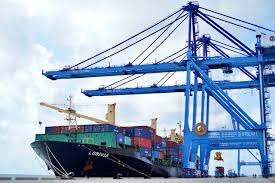
Gantry cranes at Lamu Port. (Photo/ Courtesy)
By Andrew Mwangura
Email, thecoastnewspaper@gmail.com
The Port of Lamu is swiftly emerging as a cornerstone of East Africa’s maritime and economic landscape, with the MV Lobivia and CMA CGM Gulf Express expected to dock today, signaling its growing traction as a regional transshipment hub.
The recent surge in vessel calls, exemplified by the historic arrival of the MV Nagoya Express—a 335-meter container ship, the longest ever to dock in East African waters—underscores Lamu’s potential to redefine trade dynamics in the region.
These developments reflect a broader shift in global maritime logistics, where efficiency, scale, and strategic positioning are paramount.
However, as Lamu Port gains momentum, questions linger about its readiness to serve as the region’s premier transshipment hub, the need for specialized infrastructure like dedicated livestock berths, the deteriorating road connectivity, and its broader economic significance to regional blocs, the African Continental Free Trade Area (AfCFTA), the Lamu Port-South Sudan-Ethiopia Transport (LAPSSET) Corridor, and the Northern Corridor.
The increase in vessel traffic at Lamu Port is no accident. Designed to handle ultra-large vessels that the Port of Mombasa cannot accommodate due to its 323-meter turning basin limitation, Lamu’s deep-water berths and 400-meter turning basin offer unparalleled capacity.
The MV Nagoya Express, operated by Hapag-Lloyd, loaded 140 transshipped TEUs destined for New York, demonstrating Lamu’s ability to handle high-value cargo and compete with established hubs like Djibouti and Durban.
Similarly, the MV Hong Kong Bridge and MV Zhong Gu Ri Zhao, carrying 371 and 415 TEUs respectively, highlight the port’s growing appeal to global shipping lines. The expected arrivals of MV Lobivia and CMA CGM Gulf Express today further affirm Lamu’s trajectory as a vital node in international trade routes.
The Kenya Ports Authority (KPA) has invested heavily in modern infrastructure, including high-capacity ship-to-shore gantry cranes, which enhances operational efficiency and attracts international carriers. Yet, the port’s success is not guaranteed.
Challenges such as security concerns near the Somali border and the need for robust stakeholder engagement remain critical hurdles to its long-term viability.
Is Lamu the right transshipment hub for East Africa? Its strategic location along vital Indian Ocean shipping routes and proximity to landlocked neighbors like Ethiopia and South Sudan make it a compelling candidate.
Unlike Mombasa, which has long been the region’s maritime gateway but is constrained by its 15-meter draft, Lamu’s 17.5-meter depth allows it to handle post-Panamax vessels, aligning with global trends favoring larger ships to reduce costs and emissions.
The port’s role in transshipment—transferring cargo from one vessel to another for onward delivery—positions Kenya to capture a larger share of the regional market, particularly for goods bound for Seychelles, Comoros, and Zanzibar.
The arrivals of MV Lobivia and CMA CGM Gulf Express today exemplify this potential, as they are likely to facilitate cargo transfers for regional and international destinations.
However, competition from established ports like Dar es Salaam and Djibouti, coupled with Ethiopia’s heavy reliance on Djibouti’s port, poses challenges.
For Lamu to cement its status, continued investment in infrastructure, maritime security, and regional partnerships is essential.
The KPA’s collaboration with the Kenya Coast Guard Service and Navy has mitigated piracy risks, as evidenced by Kenya’s removal from the International Maritime Organization’s piracy red list, but sustained efforts are needed to ensure safety and attract more shipping lines.

One area where Lamu could further distinguish itself is through dedicated berths for livestock handling, a critical need given the region’s significant livestock trade, particularly with markets in the Middle East.
Ethiopia and South Sudan, both key partners in the LAPSSET Corridor, are major livestock exporters, yet Lamu currently lacks specialized facilities to handle this trade efficiently.
Dedicated berths equipped with modern livestock handling infrastructure could streamline operations, reduce animal stress, and meet international sanitary standards, thereby boosting export volumes and creating jobs.
Such an investment would align with the AfCFTA’s goals of enhancing intra-African trade by facilitating the movement of high-value agricultural goods, positioning Lamu as a niche hub in a competitive market.
However, the port’s potential is hampered by deteriorating road infrastructure. The newly tarmacked road leading to Lamu is already showing signs of wear, raising concerns about connectivity to the hinterland.
The LAPSSET Corridor, a $24 billion initiative under Kenya’s Vision 2030, aims to link Lamu to Ethiopia and South Sudan through an integrated network of roads, railways, and pipelines.
Yet, the poor state of the road undermines these ambitions, threatening to bottleneck cargo movement and deter investors.
Urgent repairs and investments, such as the $166 million contract awarded to China Communications Construction Company for key road projects, are critical to ensuring seamless connectivity.
Without reliable infrastructure, Lamu risks becoming an isolated hub, unable to serve its landlocked neighbors effectively.
Economically, Lamu Port is a game-changer for regional blocs, the AfCFTA, the LAPSSET Corridor, and the Northern Corridor.
As a flagship project of LAPSSET, it promises to transform Kenya’s northern frontier, historically underdeveloped, into a vibrant trade and logistics hub.
By connecting Ethiopia and South Sudan to global markets, Lamu strengthens regional integration, fostering economic ties within the East African Community (EAC) and the Common Market for Eastern and Southern Africa (COMESA).
The AfCFTA, which aims to create a single market for 1.3 billion people, stands to benefit from Lamu’s capacity to handle increased trade volumes, particularly for landlocked countries reliant on efficient ports.
Similarly, the Northern Corridor, which links Mombasa to Uganda, Rwanda, and beyond, gains a complementary hub in Lamu, easing congestion and diversifying trade routes.
The arrivals of MV Lobivia and CMA CGM Gulf Express today further highlight the port’s role in facilitating these connections.
However, the port’s success hinges on balancing economic gains with local concerns.
Artisanal fishing, a livelihood for nearly 70% of Lamu’s population, faces risks from port activities, and issues like land rights and environmental degradation must be addressed through community engagement and sustainable practices.
In conclusion, Lamu Port’s rise as a transshipment hub, marked by the anticipated arrivals of MV Lobivia and CMA CGM Gulf Express, signals a transformative moment for East Africa.
The increasing vessel calls reflect its growing stature, but challenges like inadequate livestock facilities, deteriorating roads, and regional competition demand strategic action.

By addressing these issues, investing in infrastructure, and leveraging its strategic location, Lamu can anchor the LAPSSET Corridor, empower regional economic blocs, and advance AfCFTA’s vision of a connected Africa.
The port is not just a gateway for ships but a bridge to prosperity, provided Kenya seizes this moment with foresight and commitment.
The author is a policy analyst specializing in maritime governance and blue economy development.
About The Author