Coconut Value Chain Research Intensified to Boost the Subsector

By PATRICK AMUNAVI
Email, thecoastnewspaper@gmail.com
Researchers have intensified work on the coconut crop through research presentations on innovative technological interventions that target to enhance the value chains in the country’s coconut sub-sector, estimated to hold a potential of Ksh 25 billion.
The interventions in manufacturing, which target to benefit SMEs, are being implemented under a research initiative spearheaded by Jomo Kenyatta University of Agriculture and Technology (JKUAT), in a multi-disciplinary and multi-institutional partnership that seeks to enhance Kenya’s competitiveness in manufacturing of value added nut products, particularly the coconut.
Addressing the postgraduate student-presenters and members of the research project at JKUAT on Friday, February 3, 2023, the Research Chair Holder who is also the Deputy Vice Chancellor in charge of Administration and Finance at JKUAT, Prof. Bernard Ikua, challenged the students “to work hard in order to realize outputs that will impact the coconut value chain in Kenya and globally.”
Prof. Ikua called upon the students to be conscious of time management and remain focused in their research enterprise in order to complete their studies within the set timelines.
Noting that the research is multidisciplinary, he encouraged students “to learn and interact with each other to boost expected outcomes and improve the country’s coconut sub-sector.”

The post graduate students are beneficiaries of a research grant by the Manufacturing Research Chair on Coconut Value Addition under a 5-year project, with support from the International Development Research Centre (ICDRC) of Canada, through the Kenya National Commission for Science, Technology and Innovation (NACOSTI).
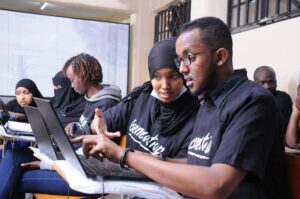
The students made presentations in the areas of tooling and machinery, beauty and cosmetics, biomass and energy, and socio-economics. Other thematic research areas include; food and beverage, textiles and fiber.
The research projects will be useful in informing the design and development of machineries, technologies and knowledge production that aims to address identified gaps in the coconut value chains in the Coastal region where the crop is grown but has not been given adequate attention for exploitation due to several challenges.
One of the presenters, Mercy Nduku Kilee, aims to develop a solar biomass tunnel dryer for coco peat drying, while Joyline Gichuki, (PhD student) is examining how the coconut fiber can be leveraged in enhancing agriculture production through soil.
Clement Mwangi Wangui, MSc student under the beauty and cosmetics research stream, is exploring anti-aging in the area of beauty and cosmetics, while Winnie Olunga is focusing on impact of value addition technologies in the coconut sub-sector, as George Odhiambo trains his spotlight on matters coconut fibre.
Larry Mukofu under the guidance of Dr. Charles Kabubo seeks to explore how the coconut husk – which is regarded as a waste product and one of the major contributor of environmental pollution in the country – can be mainstreamed at the centre of construction industry to support the affordable housing agenda.
Mukofu contends, “High demand of cement has led to higher costs of construction and requires high energy input. Furthermore it causes 5-8% of the total global CO₂, thus making it a major contributor to environmental pollution.”

Researchers across the streams gave feedback based on the research presentations – Prof. Willy Muturi (Socio Economics and Policy), Dr. Catherine Ngamau (Biomass and Energy), Dr. Walyambillah Waudo (Beauty and Cosmetics) and Dr. Hiram Ndiritu (Tooling and Machineries), Caroline Oywer (Monitoring & Evaluation).
Insightful contributions were also made by Dr. Peter Kihato, Dr. Peter Oketch, Dr. Karanja Kabini, Dr. James Wamai and Mr. Johnston Mwandi.
The research partnership brings together experts and researchers in areas of engineering, food science, economics, horticulture, chemistry, intellectual property from Multi-media University, Moi University, JKUAT, Nuts and Oil Crops Directorate, Kenya Industrial Research and Development Institute among others.
Since inception, the project has graduated several students, published articles in refereed journals, developed and deployed various low-cost-gender-sensitive technologies, conducted baseline surveys and forged partnerships with various SMEs at the Kenyan coast.
According to Prof. Ikua, the technologies include, “the husk decorticator, the Dehusker, the Stirrer, Briquetting machine, which have been distributed in Kilifi, Mombasa and Kwale counties, to help SMEs in the coconut value chains to upscale quality production.”
The Kenya National Bureau of Statistics indicate that SMEs in Kenya contribute 33% to the country’s GDP and employ more than 30 % of the population and constitute about 98% of all businesses.
Kenya produced about 109,889 tonnes of coconut in 2019 with a value of Ksh 6.8 billion. Improving the crop’s value chain is expected to boost earnings from the current annual income of Ksh 12 billion to Ksh 25 billion.
About The Author